Sunday, April 28, 2013

"The other NRA" and thoughts on workers in the retail industry in the USA


"The real cause of all this is an industry lobby called the National Restaurant Association, that we call the other NRA, that has made a deal with Congress that tipped-workers’ wages will never go up ever.  So it’s been stuck at $2.15 an hour for the last 22 years. " 

"There’s severe racial segregation. In fine dining and casual restaurants, white workers in the front, and workers of color in lower paid busser, runner, back-of-the-house positions."

- Saru Jayaraman (http://rocunited.org/)

I had purchased the newspaper called "street roots", from a vendor outside the central branch  of the Multnomah County Library, and one of the articles in it contained an interview with the labor organizer, Saru Jayaraman. The original article appeared at this website, and can be read in full here: http://realchangenews.org/index.php/site/archives/7643

It is always fantastic to hear the opinion on a social issue from someone who is working in the field: their level of understanding of the intricacies and nuances greatly improves one's understanding of the subject.  It makes one realize how indebted one is to all the people who worked and are working on improving social conditions; work that takes years of dedication with daily setbacks and challenges. I am looking forward to reading Saru Jayaraman's book "Behind the Kitchen Door". [ http://thewelcometable.net/behind-the-kitchen-door/]


It was an eye-opening article- and contained information which I had always suspected- that service workers in the restaurant industry do not make decent wages and work hard. It contains sobering statistics, and makes one wonder what one human being can subject another to- whether it was slavery until the 19th century (which continues in many parts of the world today), or sweatshop factories in poor countries.

It is one thing to read about something in a history textbook, and another to see it in front of your eyes. I had always wondered about the suffering of the restaurant workers, and if anyone had ever documented their conditions. I have never talked to any restaurant worker outside their work settings- that kind of conversation never happens in the USA (or in India for that matter). The interaction with the waiter consists of ordering food from the menu, and asking for suggestions- and then hoping to catch the waiter's attention so that I can pay the bill and leave.

I now live close to an upscale shopping district, 23rd Avenue on Burnside- it is lined with many stores that are outside my price range. Most of the stores are staffed by "hip and attractive" young people- mostly white in their 20s and 30s- at least in the front. It makes one wonder- what happens when an "ugly" person applies for a job interview? Do they get rejected because they do not have the "look" or perhaps are too "old"?  In contrast, when shopping at a super store like Fred Meyer or Safeway, you meet people with different ethnicities, and a wider spectrum in ages.

It also makes me think of a former room-mate who worked as a waiter in a restaurant in his 20s- where he had no trouble finding a job as an attractive young male- whilst he has not been able to find a job in the service industry in the past few years- perhaps it is because of his beard or his age (he is in mid-40s now).

Another friend of mine, who is a black female, was telling me about her experience working in retail- where the manager of the store wanted her to "smile more". She was wondering why the manager had singled her out, when there was another white worker in the store, with a perpetual frown on his face, who had never been asked to offer a smiling face to customers.


Thursday, April 25, 2013

A Walk at Balch Creek


On the first nice day of weather, I spent the day inside resting and hoping to rid myself quickly my cold. On the second day of nice weather Sugata decided to give me an “assignment” to get me outside: I was to spend no less than two hours on the Balch Creek path in Forest Park. I was to take photographs of nine different wild flowers, take notes on their location, find out what they were, and write about my whole experience in no less than 1500 words. As my illness was minor—just a slight scratch in my throat—I decided to give it a try.
Sugata’s idea about going to Balch Creek was inspired by our first walk down from the Audubon society last weekend where we had spent Sunday afternoon volunteering at the annual native plant sale.  We had walked up Cornell road to get there and while this route saved us time, it is not the most pleasant for the nostrils or lungs. On the way back we opted to hike down through Balch creek. It was a lovely, slow, and magical walk.  The weather was overcast, but pleasant, and the fresh air was invigorating. We saw many small wonders including a tiny salamander and a snail.
Balch Creek is apparently named after the first man in this area who murdered his son-in-law and was legally hanged.
Of course I always find naming places after people a bit absurd. People are so transient compared to the landscape, and posterity generally finds the names irrelevant and perplexing. At least in the case of Balch Creek, the name has been preserved not in an attempt to impress the undue greatness of an individual upon us, but to remind us of someone admittedly notorious. Interesting.
I set out for Balch Creek Tuesday after lunch and spent nearly three hours in the woods. There was plenty to see and learn, especially for an earnest but ignorant would-be naturalist.
There is a fair amount of foot traffic along the path. Portland residents are fortunate to have such a wonderful hiking trail so close to the city. Were it not for a few loud motorcycles that occasionally cut through the stillness, you might easily forget how close the city actually is. Many people go out for a trail run or to give their dogs some exercise. In fact, little packets of poop sometimes in yellow, white or blue baggies cab be found at intervals along the trail. Most of the trail is litter free, but for these packets of poop. The are left, I imagine because the walker does not wish to take them along for the duration. The walker imagines he or she will pick the packet up on the way back. But poop is an easy thing to forget. Let us likewise forget the poop and focus our attention on the flora around Balch Creek.
I found the first six  flowers listed here on the Lower Maclaey trail that leads up to the moss-covered stone structure built in the 1930s for picnicking and storing tools. The Fairy Bells, Evergreen violets and Salmon Berry Bushes are abundant along the trail. Trillium is not apparent at first, but not too far up the trail you will begin to see them everywhere.

If you wish to challenge yourself to a little flower trivia, you may cover the caption below, look at the picture and try to identify the species before reading. Extra points for scientific names.

1. Hooker’s Fairy Bells (Disporum hookeri)—These were the first I took a picture of and are abundant along the trail.


2. Salmon Berry (Rubus spectabilis)—Right now the bushes are dotted with fuscia blossoms with yellow centers which will later turn into yellow or red berries which are edible but not always delicious. These were found especially right smack beside the milky-colored Balch Creek.


3. Yellow Wood Violet (Viola glabella)—I found many of these in great clusters and one bunch in the direct sunlight was attracting a great variety of insects. I had to stop and test my speed at photographing insect. (Insects not pictured as the bee, who buried its face in the center of the flower obscured the markings that are helpful for identification).


4. Trillium (Trillium ovatum)—This one has kept its Latin name. A lot of variation in color, some white, some more pinkish, some reddish, some purple. These appear to be more “solitary” than the violets as I noticed individual specimens more than clusters. Each trillium seed has an oil-rich appendage that is attractive to ants. The ants lug the seeds back to their nests, eat the oil and leave the rest. This helps the trillum to spread its kind around.


5. False Solomon’s Seal (Smilacina racemosa)—I somewhat resent the labeling of plants as “false” as if the plant exists merely to trick you. “False” means that the namer, found this plant second. False Solomon’s Seal is native, though the people who named it that undoubtedly were not. The Coast Salish and the Gitksan used the roots for medicinal purposes.


6. Siberian Miner’s Lettuce (Claytonia sibirica)—The leaves of this plant look very different from the miner’s lettuce I know (Claytonia perfoliata). I noticed also that the flowers are a great deal farther away from the leaf than those of the Claytonia perfoliata. The leaves of this plant are edible, but the native peoples did not use them as food.

I stopped for a moment at the stone structure to sit on a log and journal. Here is the somewhat edited version of what I wrote:
“A Stellar’s Jay has swooped in silently. All seems still but the creek swishes by. Single lines of spider web, scattered through the shrubs catch the light. The light runs back and forth across the lines as the gentlest of breezes moves them. The jay, in taking off and landing stirs the sunlit leaves, jarring the picture of serenity, yet he has not broken the stillness with his loud voice. As a man walks by with his child in his arms, a chime sounds, presumably he just received a text message. The sound of an airplane overhead.
When I lingered long in front of the yellow flowers a woman asked me if I’d seen a snake. “No,” I said, “Just insects.” Then comes a woman with a black top, red shorts, white shoes. I take note of what she is wearing because she also happens to be walking a huge black and white great dane with a red leash. If you stop long enough you realize there are a lot of people out here. Now a group of teenagers has taken over the stone structure and are inside it hooting like idiots inside to hear their voices echo.”
After the stillness of my meditation at the stone structure was broken, I took the Wildwood trail up the slope. The following four plants were found on the hillside:

7. Wild Strawberry or Wood Strawberry (Fragaria vesca)—I used to eat wild strawberries when wandering out in the woods behind my house in Bozeman, Montana, so the blossoms are very familiar to me as are the shape of the leaves. Little did I know that there are also the woodland strawberry, the pacific strawberry, and even the coastal strawberry. I only found a smallish patch of these right along the path, so whenever they bear fruit, I’m sure they will disappear quickly. Though I must note that I have tasted a few wild strawberries in Portland, and none have seemed nearly as sweet as the wild strawberries of home.


8. Fringe cups (Tellima grandiflora)—There were plenty of these fascinating plants along the way, but it was hard to get a satisfying picture. According to my plant guide, it was said to be eaten by woodland elves to improve night vision. I'm not sure how that factoid ended up in the guide book, but I'm certainly curious.


9. Vanilla Leaf (Achlys triphylla)—only one sighting of this plant along the Wildwood trail. However, after reading my plant guide I wish to encounter it again, this time with my nose. The leaf is fragrant when crushed and can be used as an insect repellent. The Saanich of Vancouver Island kept dried bundles of them in their house to keep flies and mosquitoes away.


10. Oregon Grape (Mahonia nervosa)—the pointed jagged edges of this plant remind me very much of Holly (the plant, not my friend). The berries are edible, but not very sweet. (As a kid, I made a pen out of a hollowed out bit of cow parsley, and a shaft of a feather. I used the juice from the Oregon Grape for ink. This whole project was one of the few astonishingly successful experiments I did as a child). The shredded bark and root were used to make a yellow dye. The bark and berries were also used medicinally.


11. Herb-Robert or Robert Geranium (Geranium robertianum) This one is certainly not native, and was likely introduced as an ornamental plant. Though it is also said to repel mosquitoes, some have described the scent as “burnt rubber.” In Washington it is known as “Stinky Bob” and is listed as a noxious weed.

It's a shame to end the list with Stinky Bob, but the whole experience of photographing and staying in the woods was a treat for my senses. My eyes were scanning for flowers and my ears for the sounds of birds. I stopped for a moment on the Wildwood trail and wrote again. Here is an edited version of what I wrote in the woods:
“I pass once by a spot on the trail where a tree separates into three trunks like the tines of a pitchfork, which then branch off again. It is a rustle in the leaves at the foot of the trees that stops me and just as I have spotted a bright-chested robin, I hear another rustle and find a paler robin. I stop only a moment to watch and then move on. Yet on the way back my attention is caught by the same sound and I stop again to find the same two robins. Some time has lapsed since I was here last. Perhaps they have a nest somewhere. And as I begin to speculate and scan the visible trees for signs of a nest, I see two chickadees perched on an upright snag about ten feet tall. The snag is adorned with licorice ferns sprouting off the top like a shock of hair. The chickadees, on two different branches are quietly glancing about. I did not see them fly in. It is hard to see their dark caps against the dark cedar behind them, yet their black throats and white cheeks are highly visible. As I watch, one flies off into the woods, while another flies to a nearby alder and begins pulling of dry moss from the tree with its beak. It murmurs a soft “chickadee” call as it does so and stuffs its beak until it seems too full to fly with. Yet, fly it does straight back to the snag, where it hops into a crack and disappears.”
This moment is interrupted by a runner who jogs past with his handheld canteen. (There are a lot of runners out there!) I go up the trail a little ways and come back to observe the chickadees and write at the same spot, but am not able to witness the chickadee at work again.

It was at home that the real work of my journey began. Although I knew a few species and had some hunches about others, it took a great deal of time to search out and learn about each of the species. My main resource was Plants of the Pacific Northwest Coast, compiled and edited by Jim Pojar and Andy MacKinnon. Another helpful resource was Wikipedia which helped me find a list of likely species in the Balch Creek area. 
There are still a couple of flowers I found that remain a mystery to me. I am providing the picture so that someone else wiser (or just luckier) can help me identify them:

1. 


2. 


Saturday, March 23, 2013

More than 50 birds in a day?

Golden-crowned Sparrow

White-throated Sparrow

? Need Help with this one

Savannah Sparrow?

Profile of the Northern Shoveler from a distance

Cow zone: all good birding places have cows whether it be Ecuador or the USA

White-crowned Sparrow

Red-winged Blackbirds feeding with the sparrows: in the picture we see the male surrounded by three females (and a Golden-crowned Sparrow in front of the male Redwing)


Harris's Sparrow: An uncommon type of Sparrow


Today, Sonya and I went to Sauvie Island to view birds with the Audubon Society. We saw nearly 50 species that are listed below. We were close to a lot of the sparrows; many of them were in fact begging for food. However, the lighting was not so good- so we did not get a lot of good pictures. Many of the birds were seen through a spotting scope/binoculars, and some were identified while flying over-head/closeby- hence we do not have pictures of each and every bird. We had never seen so many kinds of sparrows- that made the trip quite special.

  1. Double Breasted Cormorant
  2. Sandhill Crane
  3. Tundra Swan
  4. Great Blue Heron
  5. Canada Geese
  6. Cackling Geese
  7. Mallard
  8. American Coot
  9. Green-winged Teal
  10. American Wigeon
  11. Northern Shoveler
  12. Northern Pintail
  13. Lesser Scaup
  14. Greater Scaup?
  15. Bufflehead
  16. Hooded Merganser 
  17. Ring Neck Duck
  18. Canvasback
  19. Bald Eagle
  20. Northern Harrier
  21. Red Tail Hawk
  22. American Kestrel
  23. Peregrine Falcon
  24. Tree Swallow
  25. Violet Green Swallow
  26. Mourning Dove
  27. Northern Flicker
  28. Downy Woodpecker
  29. American Robin
  30. Scrub Jay
  31. American Crow
  32. Common Raven
  33. European Starling
  34. Black capped Chickadee
  35. Spotted Towhee
  36. Dark Eyed Junco
  37. Red Wing Blackbird
  38. Brewer's Blackbird
  39. Bewicks's Wren
  40. Marsh Wren
  41. Song Sparrow
  42. Golden-crowned Sparrow
  43. White-crowned Sparrow
  44. White-throated Sparrow
  45. Fox Sparrow
  46. Harris Sparrow
  47. Savannah Sparrow
  48. Lincoln's Sparrow
  49. Sea Gull (do know the type)
  50. Bobolink(?)
  51. Virginia Rail (only sound heard)
  52. Great Horned Owl [? Somebody heard it hooting in the parking lot ]
  53. Bushtit [Olive on a tooth-pick- not on the island- close to our home]
  54. Rock Pigeon [close to home]
On the banks of the Columbia on Sauvie Island: We are trying to identify if the bird we are seeing is the Greater or the Lesser Scaup


Saturday, February 16, 2013

A review of an Egyptian movie: Microphone and Skyping with the Director- Ahmad Adalla on the evolution of the movie while he was making it.

Microphone: A comedy? Documentary? Fiction? Non-Fiction? Feature Film? All or none or "All and None"?

From: http://www.microphone-film.com/ 

It was a treat to get to watch the Egyptian movie, Microphone, last night at the Hollywood Theater in Portland, Oregon as a part of the 23rd Cascade Festival of African Films (http://www.africanfilmfestival.org/). This is a month long film series that takes place annually in Portland, Oregon, USA, and where one can watch all kinds of African movies, documentaries and feature films- which otherwise one would not get to see in mainstream US American theaters.

The movie is about the underground arts scene in Alexandria, Egypt and it was filmed before the Egyptian revolution. It gives one a window into the lives of the people in Alexandria, Egypt, with great street photography and cinematic skill. The political music of the bands portrayed in the movie, with subtitled lyrics, is fantastic- for both their political musical content.

Last night, following the movie, the audience had a skype conversation with Ahmad Abdalla
( http://en.wikipedia.org/wiki/Ahmad_Abdalla) about his movie.

Graffiti on the wall: a scene from the movie. Pictures from the download section of  http://www.microphone-film.com/

It was an interesting conversation with the director who was showing us how to pull off a night-out. He had been filming the night before, and had not slept through the night in order to make it for the 7:00AM local skype call with us on the west coast of the USA at 9pm. Through the conversation, it emerged that the director was an active blogger in the 2000s, and one day while he was surfing the web, he saw some pictures of graffiti taken by a fellow blogger in Alexandria. He was drawn to the art, and wanted to find out more about the artist. He found out to his surprise that the gripping work was by a 17 year old woman named Aya from Alexandria- with fantastic art work and mature political content- something that was ahead of graffiti in New York, Berlin or London. He added that graffiti was new in Egypt at that time, and he knew of only 4 artists in all of Egypt. Now there are many more artists.
Graffiti Artist Aya on the left- with co-artist in a scene from the movie  Pictures from the download section of  http://www.microphone-film.com/

He decided to make a documentary about this woman. As he started working on this project, he found out about her friends, who were in a band that played music and sang in English. He decided to include their story in his project. One of the woman's parents did not know that their daughter was in the music scene, and she would have been forbidden to perform if they knew this. The band-members would thus paint their faces with heavy mascara so that they could not be identified. The girl's parents found out about their daughter after the movie was released, and now they are OK with her playing music.

This band is called : Massive Scar Era. or MASCARA
http://www.myspace.com/massivescarera

The director, Ahmad Adalla, came to know about the underground music scene in Alexandria with 30 odd bands and decided to include this in his documentary project. When, he was asked by an audience member during the question and answer session to name his favourite American hip-hop artist, he gave a surprising answer- he was not really into hip-hop, and personally did not like it; however, he did not let his personal music taste influence his choice of bands for the movie. He did not ask any band to compose any music specifically for the movie, but recorded their music.

During the film-making process, he was questioning the idea of making a boring documentary with talking heads, and decided to make a full length fictional feature film, with incidents from the real life of the people on and off the camera. The director was open to new ideas during the filming, and in the interview he mentions how one of the singers in the movie was more used to a religious setting where he sang songs based on traditional music accompanied by traditional oriental instruments. The singer was not comfortable singing with the rock-guitar and drums, but he was asked to sing with a rock band as an experiment: he practiced with them once, and the next time they shot him singing with the band - a which made the editor's cut. In the scene in the movie, he sings a traditional song, which might have been Sufi in its origin, a powerful song blending Love for one's Lover with love for GOD, a common sleight of hand in Sufi songs, with the rock band in an apartment- and this made it one of the many epic scenes in the movie.

The director blended the real life incidents of his life and that of the main actor into the movie: themes of returning to one's hometown after years of living abroad and breaking up with a partner. He used that to showcase that some things are quite different for men and women in Egypt- simple things that men take for granted need not be true for women. The director said he wanted to portray this because this is something that is in one's face everyday. As a way of an example from real life, he related, how a week ago, his sister who is also a film maker, was questioned by the police and taking in for interrogation: the police were surprised how a single woman could be living in an apartment all by herself without a male relative- and doing something objectionable like taking still photos with her mobile camera.

He also wanted to portray the minorities in the cinema- but not just minorities in a demographic sense- based on socially constructed markers like religion or race- but based on self-identities like a musician, a graffiti artist, a skater or a hip-hop rapper. He wanted to show how people wanted to build a new identity for themselves that was not a direct copy of the past- sometime that means having to transcend things that you love like the music of the Umm Kulthum and her era. (http://en.wikipedia.org/wiki/Umm_Kulthum). He knew that many people in the East and the West had a nostalgia for Alexandria as a place where many minorities used to live in harmony,which was portrayed in the book, the Alexandria Quarted, by Laurence Durrell, ( http://en.wikipedia.org/wiki/The_Alexandria_Quartet)- but what he wanted to portray was his generation. In the interview he refused to call himself a part of the New Wave of Egpytian/and/or African cinema- but said that every person was a new wave, and there was not one New Wave but many multiplicities that we need to be cognizant of. He did not hope for one genre of things to succeed but hoped that there be place for all kinds of music in the future in Egypt and the world- whether it be rock, hip-hop or traditional music.

I felt that the director was successful in blending in music with real life -  something that is not done adroitly in a majority of Bollywood movies; where a sudden song can be jarring to the flow of story. I liked how the movie begins with just scenes depicting the characters: they are not introduced by a narrator, and that the audience has to work to make sense of the characters. Some of the scenes are comic like the woman who is the "camera-man" for the movie, telling the director that it is a bullshit idea to film her in front of the camera- he should stop philosophizing and stop shooting her- but her bored look while smoking a cigarette with a superman t-shirt is priceless- with the catch that when this scene comes on in the movie you have no way of knowing if she is going to be a major character or not. It also makes one question the notion of using the term "camera-man", and how we might have implicitly assumed that the unseen person operating the camera is a man.

The director also used innovative techniques like a person remember an event- but not chronologically- in bits and pieces- like a person would in real life. Many of the themes were depicted with a mixture of comedy and tragedy, comic timing, coincidences and with a lot of poetic undercurrents- which is a fantastic achievement in my book. This leads to a gripping movie- which blurs all the genres: comedy, tragedy, documentary, fiction, non-fiction,  feature film, and a meta-film.

I was also amazed to learn that the film-editor took nearly 8 months to edit the raw footage- this movie was a product of months of hard work by so many people; it is so much easier to consume art than to produce it.

The director mentioned another coincidence that affected the movie- the movie was released on Jan 25, 2010 (?), the day the Egyptian revolution started. According to the director Egyptians, love movies, and attend movies in droves on national and religious holidays, but after the revolution started, it was not safe for people to go to theaters- till 2-3 month later, and so the movie was not a commercial success- despised being released with 25 copies of the movie out of the roughly 400 theaters in Egypt.. It is popular now when it is shown on cable-TV and other TV broadcasts. He said that many people do not want independent movies to succeed, even ones with a chance for commercial success like his movie, because they feel that they will harm mainstream Egyptian commercial cinema, and try to work behind the scenes to stop the screening of these movies.

What this meant was that the plan he had in mind, to release a CD with many of the bands featured in the movie, never came to fruition because the movie did not make enough money to fund this project. The tacit understanding with the bands had been that he would use their music for free in the movie but produce a CD promoting their music after the movie.

This film also raises question about immigration: some of the characters in the movie want to go abroad, some are returning to Egypt after spending time abroad, some to get a Phd, others to have a working class life at a hot-dog stand.

I felt it was a delight for me to be present in the audience and listen to this informed and intelligent Egyptian- he was answering for me some of the questions I have in my own life about which themes to choose and how to go about exploring them. I really feel lucky to have found out more about keeping a receptive mind and letting things guide you as they come to you- one may not know where one is going, but one must be aware that there is a possibility for something new and exciting around the corner.


Still from the movie, Microphone.  Pictures from the download section of  http://www.microphone-film.com/


Link to the movie website: http://www.microphone-film.com/

Sunday, January 27, 2013

Ecuador January 2013

This is a pictorial blog offering a brief snapshot of our recent trip to Ecuador. We will post more detailed entries from some of the pictures shown here, and write about our experiences. It serves as a slide show to enable us to tell people about our Ecuador trip


Stone implements from the Museo Nacional, Quito, Ecuador: part of the evidence that the region was settled 15,000 to 25,000 BP.


Stone Sculpture from Valdivia Culture, Ecuador: 6000 BP to 3500 BP from Casa del Abalado, Quito, Ecuador

A sun of gold, funeral mask from ancient Ecuador: one of the prize objects at the Museo Nacional, Quito, Ecuador

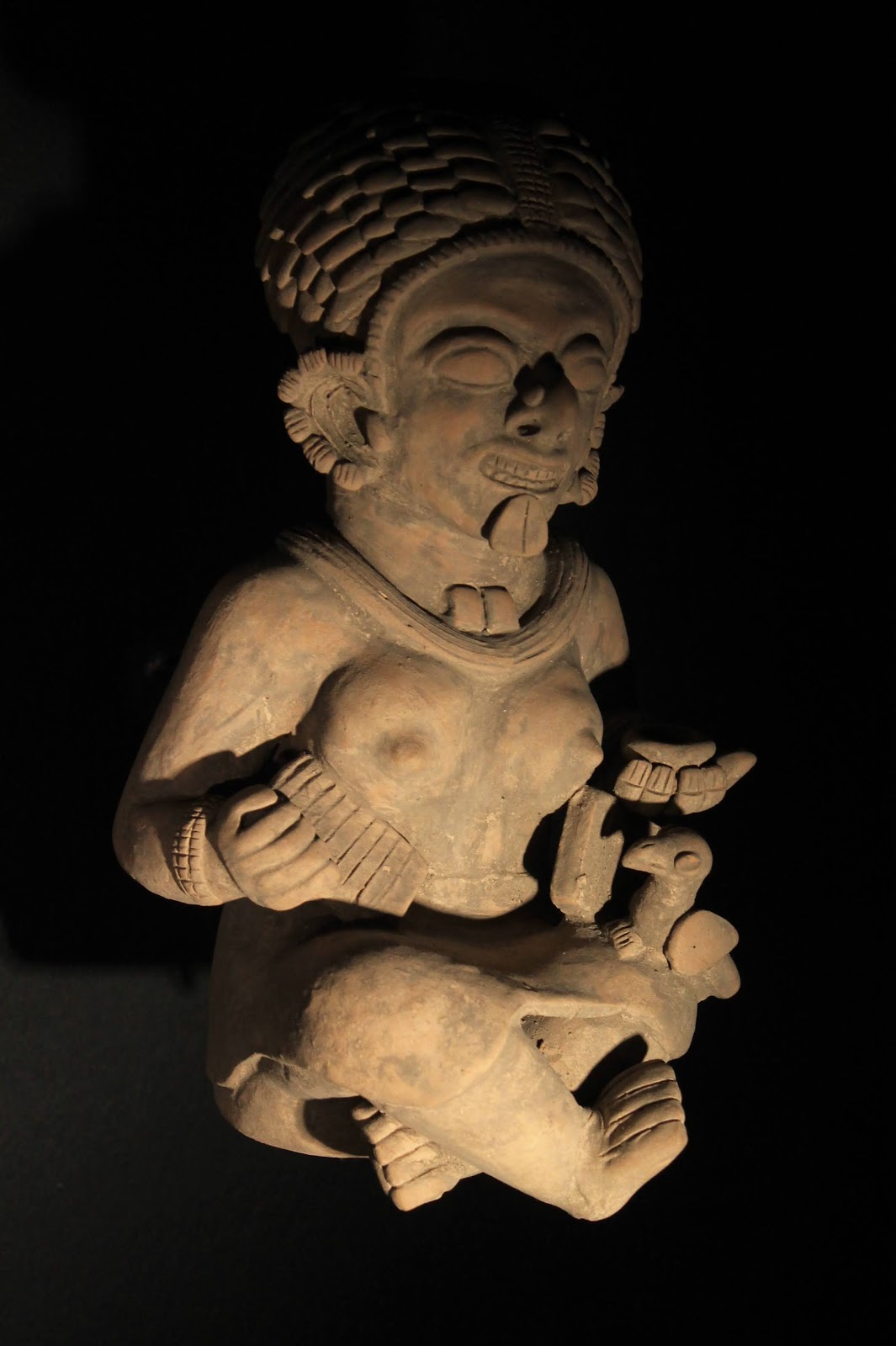
A statue from Mindalae: El Museo Etnohistórico de Artesanías del Ecuador (The Ethnographic Museum of the Artisans of Ecuador) , Quito Ecuador


Ancient Statue depicting two men chewing coca leaf from Casa del Abalado, Quito, Ecuador.