Sunday, August 26, 2012

Health Notes


This may be too much information for some of you, but if you like hearing about stomach problems, foot fungus or menstrual issues, read on. I find myself fascinated that here in Guatemala my health has taken a turn for the better despite initial setbacks.

For the first several days I had diarrhea, and though I didn’t feel particularly ill, the symptom didn’t seem to abate. Then I started feeling not quite well. I was given a wormwood tea by the member of a local family who had a great deal of confidence in its curative powers.  I felt much better the next day, yet it still seemed as if something was living in my stomach that didn’t quite get zapped with the first two doses of wormwood, as I would burp at odd times of the day, as if something else was feasting and producing waste within my system. I also lacked appetite and felt a bit queasy. I decided to get more wormwood for myself and to try a combination of fasting and wormwood tea. Wormwood, an extremely bitter substance is well-known as a vermifuge, but it is also good for reducing stomach cramps. I fasted for 36 hours and took three doses of wormwood tea throughout this period.  I’m happy to report that since that time I’ve been feeling much better and have experienced only a few irregularities in my bowel movements.

I suspect also that the altitude was affecting both Sugata and I. We both felt a little queasy all the time for the first couple of weeks. We are at 5000 feet here in San Pedro, and though I grew up at an elevation of 5000 feet, I’ve not lived at this altitude for some time.

My other early health annoyance was with the wood smoke that permeates the air in the morning as the women prepare their meals in wood-burning stoves. You can’t really go out for a walk at 6:00 without having to breathe quite a bit of wood smoke. I longed for clean air. Thus I did not go out for early morning exercise my first few week here.

Meditating on these factors, I suspected my life here would not be as healthy now as when I had been living in Portland.

Thus said I’ve noticed several improvements. First of all, I’ve slept far better here every night than I did in Portland, despite a great deal of noise from the street (firecrackers, dogs, loud bands, radios). Second, I usually experience some pain early on during my period, but here, I’ve not felt a twinge of menstrual pain. Third, my feet seem to have become less susceptible to athletes foot. I’ve been wearing the same closed-toed shoes, without socks to my class for weeks now. Under normal circumstances this would give me raging athlete’s foot, but that has not been the case. When I first arrived here, I already had a little athlete’s foot, but it seems to have completely cleared. The worst I’ve suffered is stinky feet (which incidentally Sugata has taken it upon himself to cure by mandating that I purchase open-toed shoes. I’m wearing them now). Forth, though I’ve not weighed myself, I’ve definitely not had any significant weight gain, despite being nearly sedentary. It appears also that Sugata has lost a little bit of his belly. Fifth, Sugata’s eye seems to be doing. It was bothering him quite a bit even while we were traveling in the states but he no longer has problems with it.

What is the factor? Why am I doing so much better here, health wise? I have a hard time telling for sure as almost everything about my diet here is completely different. It is not so much that I am eating completely different foods, so much as that some are nearly absent and others are being consumed far more frequently than I used to, including some (such as white bread) that I don’t think are ultimately so good for me.

Note that these foods are eaten in a variety of combinations, but these are the basic ingredients that are eaten in some form.
 

Almost every day
Tomatoes
Lemons
Onions
Avocadoes
Corn tortillas
Watermelon (during the break at school)
Pineapple (during the break at school)
Salt
Spices (Chili, cumin, curry)

Every other day
Black beans
Parboiled Rice
Atol de Haba (porridge-like drink of broad beans)
Garlic

Twice a week

White bread
Eggs
Chocolate (the kind you mix in a drink, bought in cakes at the market)
Cucumber
Zucchini
Carrots
Pasta
Canola oil for cooking foods
Tostada shells

Once a week
Coconuts
Tomatillos
Potatoes
Bananas
Greens (spinach, chipilin, and unidentified green)
Beets (in very small portions on a tostada)
Wisquil (Green vegetable pictured in Sugata's earlier pic post)

Once in awhile
Oats
Eggplant
Strawberries
Fresh cheese
Cashews
Sweet bread
Plantain
Hibiscus tea
Whole-grain rice

Once or Twice so far
Yucca
Tofu
Broccoli
Cabbage
Pumpkin seeds
Peanuts
Apples
Orange juice
Roasted barley
Tamarind
Cookies my teacher brought me

For the last couple of weeks I have started running early in the morning. But that’s for my next blog post.

Tuesday, August 7, 2012

Scenes from the Market

We bought Tostadas from this woman at the Market


Tostada with beans, guacamole, eggs, onions, and chowmein!

We bought strawberries from this woman at the market.


Fish being sold at the marker: it is mostly small dried fish. I will post of the tragedy of the fish of the Lake Atitlan at a different blog post

Main Street San Pedro: La Calle Principal

Wisquil (tastes like Lao when boiled in lentils), next to Carrots

Vegetable Grocer

We bought lentils and mung-beans from this person

There are many more things sold at the market including things we do not know about. We are planning to create a blogpost entitled: ¨Mysteries of the Market¨ soon.

Food bought at the market last Sunday, August 05


Bananas and Strawberries

Tomatillos and Tomatoes

Aguacate


Zucchini, Apple, Eggplant, Lemon, Potato, Pepper, Onion, and Ginger 

Strawberries

A young Coconut. They chop all the external fiber off and only a small portion of the flesh is exposed at the top. One can drink the water, and scoop out the rest of the flesh. Yum!


Some of the food we have been eating

Tostadas: Fried Maize Tortillas: Green paste is with Guacamole, Red is Tomato  paste, brown is mashed black beans  Q20


Pupusa: Cheese stuffed Tortillas with black beans with a sprinkling of cheese, one bowl contains guacomole, the other contains salsa Q20


A plate of rice with Steamed veggies: beautiful arrangement Q25

Tofu Sandwich with roasted tomatoes and onions, with a side of fried potatoes Q35

Just a snapshot of some of the food we ate at a coupe of Restaurants in Panajachel  last Saturday.

Friday, August 3, 2012

Beans and Tortillas


Corn, maiz, or ixiim
Sugata was out getting groceries one evening in the open market and could not find the girl that sold the  tortillas. He stopped to ask a bread-seller where else he might find some. She directed him to a door on one of the side streets. Upon entering he climbed the stairs, walked down the hall and entered into somebody´s large, dimly lit kitchen. A pile of wood was stacked against the wall, and atop the wood, slept a black and white cat. A wood-burning stove made the room warm and a woman flipped fresh corn tortillas atop the stove. Corn sat soaking in plastic tubs on the floor. Two other women graced the room--one much younger than the tortilla flipper, and one much older. It felt strange, to be sure, walking into what appeared to be someone´s private residence, but there were the tortillas.


"I would like to buy tortillas," Sugata said, in his masterful Spanish.
"How many?"
"Three quetzales worth." 

By this time he knew the market price: one quetzal for four tortillas

"We have beans too," one woman said as he left.

But we were determined to cook our own beans.


Avocados, yet another delight!
We had purchased dry beans at the market and I had soaked them all day. In the eveningI began to cook them on our gas burner. After an hour and a half, I sampled them. Still quite crunchy. Another hour and a half and I still wasn´t satisfied, but gave up and had slightly crunchy beans for the evening.  I´d cooked beans plenty in Portland, why did it take so long here? And why especially since it was such a staple? I balked at the idea of using so much gas just to cook beans, so I gave up not only for the evening, but for my stay in Guatemala holding to the hope that there were cooked beans aplenty.


The next time at the market we went we brought along an empty pot for beans. The youngest of the three generations of women began chatting with us. What are your names? Where are you from? Sugata made her guess his country of origin and was pleased when she first thought Mexico. She had a young son--a year away from starting school. Later that evening hollered and waved at us from the window as we shopped for avocados just below his house. We are regulars now.

But the market is somewhat far from our house, and very much uphill from us. We are occasionally lazy and
so on one of our lazy days, Sugata began asking around the neighborhood where one could buy beans and tortillas. 

The interesting thing is that so many people sell these essential food items from their homes. We took some time to follow directions to a house just up the street from us. We squeezed through the alley which opened into an area where clothes had been hung out to dry. A small girl played nearby, her mother still busy hanging T-shirts. "Hola. Vende frijoles y tortillas?" The woman assures us that yes, she sold beans and tortillas. We produced our pot and the little girl ran to fill it with seven quetzales of beans. 

The next day when we bring our pot for our daily bean ration, they aren´t selling beans and direct us to another house a block away. Once again we must poke our heads into someone’s dark kitchen and ask for a few beans. I still haven’t gotten used to it, though the intimacy of the experience fascinates me.

According to my Spanish teacher, most people here do not have refrigerators and use wood burning stoves to cook their food. The smell of wood smoke begins to waft into the air at around 6 a.m. and is thicker than I care for, though now I seem to have become desensitized. The challenge of being without a refrigerator is that you cannot cook too many beans all at once. My teacher tries to cook only enough for two days, heating the beans well the second day to kill anything that may have tried to developed. If the beans are not finished by day two, they likely go to waste. 

I learned about this because I asked my teacher "Como estas?" one morning and she actually answered honestly. She was fine now, but the night before she hadn’t had time to cook beans and her husband had gone to the market to buy some. Neither seemed to noticed that the beans were a little foamy, a little glue-like, a little whiter than they should have been. “There was no odor,” she said, but that night she was sick to her stomach most of the night and had to take some medicine to settle it down.

Ever since I have looked carefully at the beans we buy. For the most part we have gone back to the women just next to the market.

For several mornings we have woken up to a sound of something curiously similar to a diesel generator. What was it? For the longest time we didn´t know, but Sugata verified that the sound could be reliably used as an alarm. He claimed it started at 5:25 a.m, but I have since caught it as early as 5:00, and there are many more sessions of the sound later in the morning. On a walk one morning, we found that the sound was coming from a mini-mill. Women bring tubs of dried corn that has been treated with lime and soaked overnight. They grind the corn there at the mini mill for those daily tortillas we find in the market and in homes around the town.

I love watching them make tortillas here. The lump of dough, scraped from the tub, the sound of a tiny applause as they pat the lump into a tortilla. The applause continues in my mouth after they take it hot off the stove. One more round of applause for the wonder of fresh, hot tortillas.

Sunday, July 15, 2012

Chicken Bus

I’m sure that nearly every foreign traveler in Guatemala, has her own story of riding a “chicken bus.” I fear my words will fail to live up to the experience of it, but here we go: We left Hotel La Casa de Don Ismael, in Antigua, Guatemala without consulting our map. It was not out of foolishness we did this, but from relying on our faint memory from a similar journey years ago in the same place. We headed in the general location of the market at the edge of town, behind which we would find rows of colorful chicken busses which could take us to a variety of different destinations.  We were looking for a bus to Panahachel, when a young man jumped into our path to advertise his bus to Chimal. “Pana,” Sugata replied, which was met with a stream of Spanish which I took to mean “This bus will go through Panahachel on the way to Chimal. We shook our heads and moved on, then ducked behind another bus to consult our guidebook. Ah, yes.  According to the book, we couldn’t catch a direct Chicken Bus to Panahachel and would have to transfer in Chimal. So my translation hadn’t been quite accurate, but the essence was the same. We needed to get on a bus headed to Chimal. But instead of getting on the young man’s scarcely populated red and yellow bus, we ascended into a green bus to Chimal which was already pulling out of the station.
The bus wasn’t very crowded. And only a few black plastic bags were tucked onto the shelves above, as well as a few knapsacks. Our bags were too large to put on the shelves, so we each took our own seat, uncertain as to how we might crowd both our backpacks and the two of us onto one seat, and as of yet, there was no need. Though the bus had appeared ready to leave, the progress from bus port to street was painstakingly slow. As the bus inched forward and stopped, inched forward and stopped, in popped a beggar asking for handouts. Then a man with fireman’s hat and coat entered, made a speech, collected a few Quetzals as he made his way through, and exited at the rear of the bus.  More passengers began to hop on as the bus worked its way to the street.
Sugata motioned for me to join him, and after arranging our backpacks a couple of times, we managed to squeeze everything onto one seat. Really, what excuse had we? A family of four would later sit two seats in front of us.
Just then, a discreet foreigner popped into the bus and took the seat which I had so recently evacuated. She tightened her tiny ponytail and in a moment was flipping through a stack of 3X5 cards. “She’s studying Spanish,” I whisper to Sugata. “Talk to her,” he says. I hesitate as I peer over her shoulder at the cards she’s holding.
The driver turns on some lively music and the bus ride begins to feel like a festive occasion. When I look up I realized that not only do we have audio, but video, complete with men who look like they think they’re oh-so- cool, and women shaking their scarcely-clad “stuff.” A stuffed toy monkey clings to the side of the screen. His companions, a small white bear and a brown bear, sit next to him, each holding a red velvet heart.  From the driver’s mirror dangles a CD painted with the figure of the Virgin Mary. It swings back and forth as the bus jolts along.
After a good long while of alternating my gaze between music video and passing scenery, we are out of town. The driver takes us into the curves, full speed ahead. It is then that I remember what riding a chicken bus is all about, that not only will I listen to festive music, but I’ll be taking roller coaster ride without the benefit of security straps. I grab onto the bar in front of me with both hands and hang on. Lucky me, I have the aisle seat. By the time this bus journey is over, I will feel like I’ve been to one of the more strenuous Cross-fit workouts. 
It’s surprising that such a bus, packed with so many people, can fly up these turns so fast. It’s also surprising that quite a lot of the natives on the bus can nap or eat quite comfortably under such conditions.  Occasionally the bus stops to pick up more people, and I can, in those moments unclench my hand. It is in one of these lulls when I finally tap the foreigner on the shoulder.

“Are you studying in Antigua,” I ask, “No,” she says, “Panahachel.” We have time for a few more words before we must brace ourselves against the curves.  She’s been in Pana for some months, but has just taken her husband to the airport and will study in Pana a month and a half more. She becomes our unofficial guide. She’s been there. She knows what she’s doing.  So when she hops off saying “This is where I got on yesterday coming down. No promises,” We hurry off the bus after her.
Three buses later we are in Panahachel.

A Week in Guatemala

It has been a week since Sonya and I have landed in Guatemala.

We have started our Spanish classes at the picture perfect garden school in Casa Rosario by the shores of the Lake Atitlan. It has been somewhat strange for me to learn a European language, Spanish, from a fellow colonized subject. It should not be; after all the teachers I had in the U.S.A. were from Mexico and Argentina. As I think more about this, I am beginning to think that the reason for this dissonance is that I expected Spanish in Guatemala to be no different than English in India: only the elite upper and upper middle classes to be speaking it.

India is not Thailand or Kerela with near cent per cent literacy, and I was expecting the same in Guatemala.
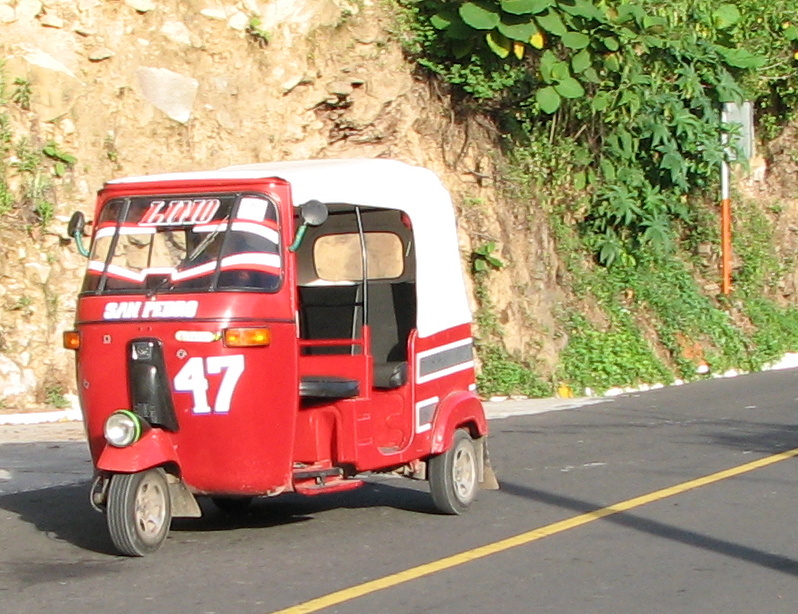
However here, everyone speaks Spanish: the immigration official, the shuttle-bus driver, the chicken-bus driver,¨El capitan¨ of the launches on the Lake Atitlan, the auto-drivers (tuk-tuk), the old woman in the market selling rounds of sin-azucar chocolate wrapped in leaves, the woman making tortillas, even the little girl who is vending peanuts and fava-beans. India, if any of them had spoken English to me- I would be shocked.

The other reason for the dissonance is that my mind is tricked into believing I am in India time and again: physically the way I have to manoeuver my body in the market place is the same as India; I need nimble feet and alert eyes, rather than the encumbrance of a shopping cart on the smooth floor of a supermarket. Concrete structures topped with exposed twisted iron rebars promise future vertical construction. Aurally, the noises I hear are the same: four-stroke engines from the same vehicles- Bajaj Autos and Pulsars, dogs barking so louldly at night that they wake me, distant roosters and ashtmatic trucks. And wood-smoke and diesel exhaust smell the same.


The kids playing soccer in the street below do it in Spanish. I was expecting to hear more of the local language and be lost in known non-comprehension, similar to the way I do not understand conversations on the bus or the train in Andhra Pradesh or Tamil Nadu, and not be taxing my brain trying to understand what they were saying.

My Spanish teacher who is of Mayan heritage learnt Spanish in school; she did not learn her native Tzu´tuhil in school, she is in the same boat as I am with Bengali: she can speak it- but cannot write it, according to her there are less than a dozen Tzu´tuhil literates in San Pedro- a town of around 10,000 people. She tells me that her children are now learning Tzu´tuhil in school with the Roman alphabet.

I am pondering about the ways in which language influences the marketing of products of daily consumption. How do certain memes take on significance in one culture and not others. For example would one buy soap or beer in India if it were called ¨Murga Brand¨ or in the USA as ¨Rooster Brand¨?