Friday, August 3, 2012

Beans and Tortillas


Corn, maiz, or ixiim
Sugata was out getting groceries one evening in the open market and could not find the girl that sold the  tortillas. He stopped to ask a bread-seller where else he might find some. She directed him to a door on one of the side streets. Upon entering he climbed the stairs, walked down the hall and entered into somebody´s large, dimly lit kitchen. A pile of wood was stacked against the wall, and atop the wood, slept a black and white cat. A wood-burning stove made the room warm and a woman flipped fresh corn tortillas atop the stove. Corn sat soaking in plastic tubs on the floor. Two other women graced the room--one much younger than the tortilla flipper, and one much older. It felt strange, to be sure, walking into what appeared to be someone´s private residence, but there were the tortillas.


"I would like to buy tortillas," Sugata said, in his masterful Spanish.
"How many?"
"Three quetzales worth." 

By this time he knew the market price: one quetzal for four tortillas

"We have beans too," one woman said as he left.

But we were determined to cook our own beans.


Avocados, yet another delight!
We had purchased dry beans at the market and I had soaked them all day. In the eveningI began to cook them on our gas burner. After an hour and a half, I sampled them. Still quite crunchy. Another hour and a half and I still wasn´t satisfied, but gave up and had slightly crunchy beans for the evening.  I´d cooked beans plenty in Portland, why did it take so long here? And why especially since it was such a staple? I balked at the idea of using so much gas just to cook beans, so I gave up not only for the evening, but for my stay in Guatemala holding to the hope that there were cooked beans aplenty.


The next time at the market we went we brought along an empty pot for beans. The youngest of the three generations of women began chatting with us. What are your names? Where are you from? Sugata made her guess his country of origin and was pleased when she first thought Mexico. She had a young son--a year away from starting school. Later that evening hollered and waved at us from the window as we shopped for avocados just below his house. We are regulars now.

But the market is somewhat far from our house, and very much uphill from us. We are occasionally lazy and
so on one of our lazy days, Sugata began asking around the neighborhood where one could buy beans and tortillas. 

The interesting thing is that so many people sell these essential food items from their homes. We took some time to follow directions to a house just up the street from us. We squeezed through the alley which opened into an area where clothes had been hung out to dry. A small girl played nearby, her mother still busy hanging T-shirts. "Hola. Vende frijoles y tortillas?" The woman assures us that yes, she sold beans and tortillas. We produced our pot and the little girl ran to fill it with seven quetzales of beans. 

The next day when we bring our pot for our daily bean ration, they aren´t selling beans and direct us to another house a block away. Once again we must poke our heads into someone’s dark kitchen and ask for a few beans. I still haven’t gotten used to it, though the intimacy of the experience fascinates me.

According to my Spanish teacher, most people here do not have refrigerators and use wood burning stoves to cook their food. The smell of wood smoke begins to waft into the air at around 6 a.m. and is thicker than I care for, though now I seem to have become desensitized. The challenge of being without a refrigerator is that you cannot cook too many beans all at once. My teacher tries to cook only enough for two days, heating the beans well the second day to kill anything that may have tried to developed. If the beans are not finished by day two, they likely go to waste. 

I learned about this because I asked my teacher "Como estas?" one morning and she actually answered honestly. She was fine now, but the night before she hadn’t had time to cook beans and her husband had gone to the market to buy some. Neither seemed to noticed that the beans were a little foamy, a little glue-like, a little whiter than they should have been. “There was no odor,” she said, but that night she was sick to her stomach most of the night and had to take some medicine to settle it down.

Ever since I have looked carefully at the beans we buy. For the most part we have gone back to the women just next to the market.

For several mornings we have woken up to a sound of something curiously similar to a diesel generator. What was it? For the longest time we didn´t know, but Sugata verified that the sound could be reliably used as an alarm. He claimed it started at 5:25 a.m, but I have since caught it as early as 5:00, and there are many more sessions of the sound later in the morning. On a walk one morning, we found that the sound was coming from a mini-mill. Women bring tubs of dried corn that has been treated with lime and soaked overnight. They grind the corn there at the mini mill for those daily tortillas we find in the market and in homes around the town.

I love watching them make tortillas here. The lump of dough, scraped from the tub, the sound of a tiny applause as they pat the lump into a tortilla. The applause continues in my mouth after they take it hot off the stove. One more round of applause for the wonder of fresh, hot tortillas.

Sunday, July 15, 2012

Chicken Bus

I’m sure that nearly every foreign traveler in Guatemala, has her own story of riding a “chicken bus.” I fear my words will fail to live up to the experience of it, but here we go: We left Hotel La Casa de Don Ismael, in Antigua, Guatemala without consulting our map. It was not out of foolishness we did this, but from relying on our faint memory from a similar journey years ago in the same place. We headed in the general location of the market at the edge of town, behind which we would find rows of colorful chicken busses which could take us to a variety of different destinations.  We were looking for a bus to Panahachel, when a young man jumped into our path to advertise his bus to Chimal. “Pana,” Sugata replied, which was met with a stream of Spanish which I took to mean “This bus will go through Panahachel on the way to Chimal. We shook our heads and moved on, then ducked behind another bus to consult our guidebook. Ah, yes.  According to the book, we couldn’t catch a direct Chicken Bus to Panahachel and would have to transfer in Chimal. So my translation hadn’t been quite accurate, but the essence was the same. We needed to get on a bus headed to Chimal. But instead of getting on the young man’s scarcely populated red and yellow bus, we ascended into a green bus to Chimal which was already pulling out of the station.
The bus wasn’t very crowded. And only a few black plastic bags were tucked onto the shelves above, as well as a few knapsacks. Our bags were too large to put on the shelves, so we each took our own seat, uncertain as to how we might crowd both our backpacks and the two of us onto one seat, and as of yet, there was no need. Though the bus had appeared ready to leave, the progress from bus port to street was painstakingly slow. As the bus inched forward and stopped, inched forward and stopped, in popped a beggar asking for handouts. Then a man with fireman’s hat and coat entered, made a speech, collected a few Quetzals as he made his way through, and exited at the rear of the bus.  More passengers began to hop on as the bus worked its way to the street.
Sugata motioned for me to join him, and after arranging our backpacks a couple of times, we managed to squeeze everything onto one seat. Really, what excuse had we? A family of four would later sit two seats in front of us.
Just then, a discreet foreigner popped into the bus and took the seat which I had so recently evacuated. She tightened her tiny ponytail and in a moment was flipping through a stack of 3X5 cards. “She’s studying Spanish,” I whisper to Sugata. “Talk to her,” he says. I hesitate as I peer over her shoulder at the cards she’s holding.
The driver turns on some lively music and the bus ride begins to feel like a festive occasion. When I look up I realized that not only do we have audio, but video, complete with men who look like they think they’re oh-so- cool, and women shaking their scarcely-clad “stuff.” A stuffed toy monkey clings to the side of the screen. His companions, a small white bear and a brown bear, sit next to him, each holding a red velvet heart.  From the driver’s mirror dangles a CD painted with the figure of the Virgin Mary. It swings back and forth as the bus jolts along.
After a good long while of alternating my gaze between music video and passing scenery, we are out of town. The driver takes us into the curves, full speed ahead. It is then that I remember what riding a chicken bus is all about, that not only will I listen to festive music, but I’ll be taking roller coaster ride without the benefit of security straps. I grab onto the bar in front of me with both hands and hang on. Lucky me, I have the aisle seat. By the time this bus journey is over, I will feel like I’ve been to one of the more strenuous Cross-fit workouts. 
It’s surprising that such a bus, packed with so many people, can fly up these turns so fast. It’s also surprising that quite a lot of the natives on the bus can nap or eat quite comfortably under such conditions.  Occasionally the bus stops to pick up more people, and I can, in those moments unclench my hand. It is in one of these lulls when I finally tap the foreigner on the shoulder.

“Are you studying in Antigua,” I ask, “No,” she says, “Panahachel.” We have time for a few more words before we must brace ourselves against the curves.  She’s been in Pana for some months, but has just taken her husband to the airport and will study in Pana a month and a half more. She becomes our unofficial guide. She’s been there. She knows what she’s doing.  So when she hops off saying “This is where I got on yesterday coming down. No promises,” We hurry off the bus after her.
Three buses later we are in Panahachel.

A Week in Guatemala

It has been a week since Sonya and I have landed in Guatemala.

We have started our Spanish classes at the picture perfect garden school in Casa Rosario by the shores of the Lake Atitlan. It has been somewhat strange for me to learn a European language, Spanish, from a fellow colonized subject. It should not be; after all the teachers I had in the U.S.A. were from Mexico and Argentina. As I think more about this, I am beginning to think that the reason for this dissonance is that I expected Spanish in Guatemala to be no different than English in India: only the elite upper and upper middle classes to be speaking it.

India is not Thailand or Kerela with near cent per cent literacy, and I was expecting the same in Guatemala.
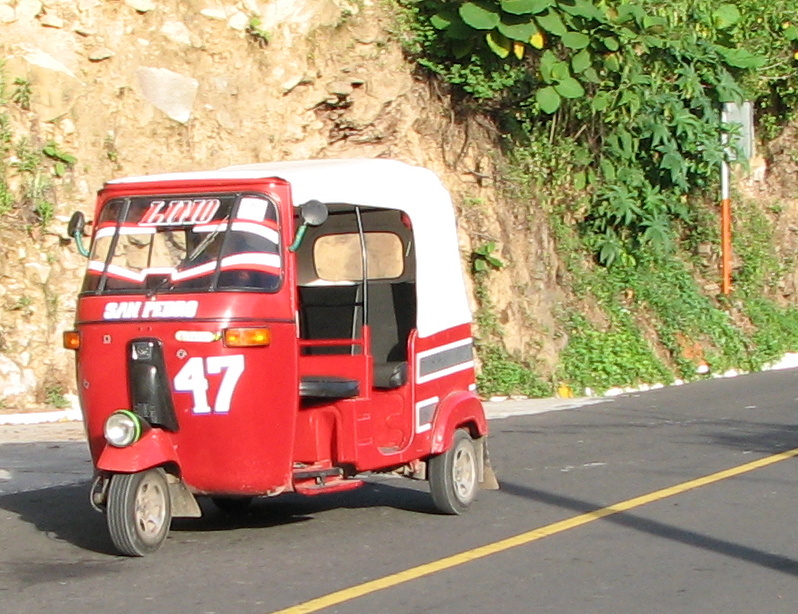
However here, everyone speaks Spanish: the immigration official, the shuttle-bus driver, the chicken-bus driver,¨El capitan¨ of the launches on the Lake Atitlan, the auto-drivers (tuk-tuk), the old woman in the market selling rounds of sin-azucar chocolate wrapped in leaves, the woman making tortillas, even the little girl who is vending peanuts and fava-beans. India, if any of them had spoken English to me- I would be shocked.

The other reason for the dissonance is that my mind is tricked into believing I am in India time and again: physically the way I have to manoeuver my body in the market place is the same as India; I need nimble feet and alert eyes, rather than the encumbrance of a shopping cart on the smooth floor of a supermarket. Concrete structures topped with exposed twisted iron rebars promise future vertical construction. Aurally, the noises I hear are the same: four-stroke engines from the same vehicles- Bajaj Autos and Pulsars, dogs barking so louldly at night that they wake me, distant roosters and ashtmatic trucks. And wood-smoke and diesel exhaust smell the same.


The kids playing soccer in the street below do it in Spanish. I was expecting to hear more of the local language and be lost in known non-comprehension, similar to the way I do not understand conversations on the bus or the train in Andhra Pradesh or Tamil Nadu, and not be taxing my brain trying to understand what they were saying.

My Spanish teacher who is of Mayan heritage learnt Spanish in school; she did not learn her native Tzu´tuhil in school, she is in the same boat as I am with Bengali: she can speak it- but cannot write it, according to her there are less than a dozen Tzu´tuhil literates in San Pedro- a town of around 10,000 people. She tells me that her children are now learning Tzu´tuhil in school with the Roman alphabet.

I am pondering about the ways in which language influences the marketing of products of daily consumption. How do certain memes take on significance in one culture and not others. For example would one buy soap or beer in India if it were called ¨Murga Brand¨ or in the USA as ¨Rooster Brand¨?


Friday, June 29, 2012

Sweat

"It must be hot riding out here," the tall guy said as he approached us. We were just leading our bikes and trailers out of the service station where we had used the restrooms. He had strayed from the side of his pickup truck specifically to talk to us. 

 I shook my head. "It's not so bad," I said, "We sweat..."

"...and burn calories, shed fat, and all that," he finished, nodding, supposing like most people do that the most important function of sweating is losing weight.

"No," I said, "What I mean is that when you sweat and you are moving, there is this wind that you create by your own movement and..." I'm not sure he followed my words. He thought he already knew what I was going to say. But since I didn't get the satisfaction then of elaborating for that man my most recent delightful discovery, I'm going to share it here, with you.

We started our 300+ mile cycling journey in Washington D.C. just across from the Watergate towers. Though it was only 7:30 a.m, the air was warm and moist. We were excited to begin our journey. The canal towpath was lined with brick houses and pretty bridges on each Georgetown city block- each one a perfect postcard picture. The trail was marvelously shaded by a canopy of trees, but as the day wore on, the sun scooted higher and higher and the air became hotter and hotter. Sweat poured off us as we We bumped along over a rough dirt and gravel paths, sweat pouring off us, as our trailers dutifully clattered behind us, collecting dust.

It was on the first day of this journey that I rediscovered the age-old technology of sweat and its crucial pairing with movement. In this case, the speed of the bicycle perfectly complemented the amount of sweat I produced in order to keep me at a comfortable temperature. As long as I kept moving, I kept cool. When I stopped to rest or to refill water, I quickly grew hot quickly. So I kept riding.


Sugata and I used other means to keep cool. We bathed in the Potomac River, doused ourselves at  water pumps, removed our shirts as we rode and allowed the air to directly touch our sweaty skin. But of all these methods, it was my own sweat that fascinated me most that day. I could not help but feel proud of this liquid I produced and the entirely natural cooling process that accompanied it. I could not help but think that humans were indeed born to move and to be far more active than we are today. We are one of the sweatiest animals on the planet and our nearly bare skin helps to accentuate the effectiveness of our sweat. Yet what do we do?

Not long before beginning this bike journey I started rereading Walden. Thoreau writes about how dependent people have become on fire. What once was a luxury, he said, had now become a necessity.  Of course he didn't mean a necessary necessity, rather he lamented the fragility of modern human beings. It was reasonable, he thought, for humans to clothe and shelter themselves, but they had weakened their bodies' natural response by relying too much on fire.

I have to wonder likewise about the air-conditioning that has become "a necessity." We sit around so much that we require our environments to do the work of cooling (and heating) us. We have air-conditioned offices. We have air-conditioned cars where we "move" without exertion. Even gyms have air-conditioning, "necessary" because in gyms people move in place on treadmills. The air does not naturally flow past them as it would if they were walking outside. 

Movement seems to be the cure for being either too cold or too warm, yet we seem unwilling to rely on our own bodies to regulate our temperature. What do you think about this?


Anyway, that is all for now. I'll soon be out sweating under a canopy of trees.


Thursday, June 28, 2012

200 miles into the Bike Ride


Here I am in Frostburg, MD looking out of the tent, as the sky which was the colour of artificially tinted farm raised salmon, is punctured at the horizon by a bright orange LED which is turning yellower every second, and is mysteriously bright enough to turn the sky to a more natural wild sockeye salmon pink, whilst also transforming the hillside I am sitting on, under a tree in a terraced campground, into lighter and lighter shades of military olive green from the blue grey tint it had a few minutes ago.
I am back in my tent writing this entry having taken a shower in what the owner justifiably claims is the cleanest bathhouse in the country, while having just watched the 1891 Frostburg railway depot appear magical, picture perfect like in a holiday greeting card- being bathed by the soft glow of the LED on the horizon, and a more natural orange glow emanating from the beautifully arranged sodium vapour lamp-posts around the train yard, magical even without the steam-engine hauling tourists that will be using the round-table later in the week.

Sonya and I are 200 miles into the 335 mile bicycle trip: from Washington, DC to Pittsburgh, PA. It has been nearly a week that we have been camping every night as we take a day of rest before crossing the Eastern Continental divide tomorrow.

There are many aspects about the journey to write about so far: the physical exertion needed to ride a bicycle 200 miles, and how that can be different over different terrains and climates; from the blazing hot sun yesterday on a steady 1.5% climb on a smooth railroad grade to the cool  shady canal path navigating twigs, sticks and broken branches, to the history of transportation exemplified by a marker on the West Maryland Rail Trail which mentioned how on the rail trail one could see different means of transportation at the same time, the rail trail we were on, the canal tow-path to the left, and Interstate-68 on the right, on the people who used to depend on the canal for their livelihood in the mid-nineteenth century, why slave labour was or was not used in the building of the bike path we rode on, questions regarding sustainability in the markers mentioning the sites of now-extinct cement factories and mines, to the lives of the National Park Service employees demonstrating the operation of locks to visitors,  to the class, gender, so-called race, age aspects of bicyle touring, the wild life we saw, and did not see, and what people choose not to see even when they see the evidence in fossils, John Brown, Nat Turner, and the lack of ferries named after them, friends I wish I could be riding with, and the mysterious creature who ate our pizza left on the bike rack overnight.

The sun is higher up in the sky now- things are still magical-this is the golden hour that photopgraphers love for a good reason. The plastic bottles of water in the campsite below our terrace level, occupied by a woman and a young boy- an atypical combination on this trip- is tinted orange with the nectar of life.

Yesterday, a concerned worker at the campground told the mother of a six year old that her son needs to be more careful riding his bike while the kid engaged in random Brownian motion twenty feet away. The worker said that he had told the kid not to ride on the main street leading to town as there are crazy people doing 90. The mother trying to corrall her two unleashed dogs magnetically drawn to the cafe by the fried chicken apologized, and said that her son had not told her about this, and that she would instruct him to be careful in the future.

In Hancock, Maryland the day before, Sonya and I were sitting on a park bench while nibbling the last remains of our brunch: bagels, shredded cheese, avocados, tomatoes, peppers. An 8 year old boy rolled into the park on a single speed BMX bike with two sauce pan sized wire gauze containers in his hand. He made a seamless transition from riding his bike to dropping it on the grass, and dissapeared into the bushes  obstructing the C&O canal from view. A minute or two later, he was followed a boy the same age and a slightly older girl. Before they too ducked into the bushes, I asked them- What are you catching? Minnows was the quick reply and these two were also swallowed by the bushes.

Five mintues later, the kid who had replied to me, emerged from the bushes, and picked up the dropped bike. We were in a covered pavillion, and there were a couple of park benches 20 metres away across a small dip in the ground. The kid got on the BMX, pedalled 5-6 complete rotations, and then sat down on his seat as the bike started gathering speed on the downhill. 2 seconds later, as the U-shaped ground under him turned flat he tried lifting his bike from under him- the front wheel lifted off a foot from the ground while the back wheel stayed in contact as he rolled to a stop on the level ground. He repeated the procedure from the other side, and had the same success as he approached us. After 3-4 more attempts, he slumped to a bench in the pavillon we were in and inspected our bikes. "Can't do it anymore," he said, "On my first try, I went this high." He was trying to get both wheels high off the ground- his goal was as high as the tables in the pavillon- about 3 feet. He talked about some older kid who could get higher- he motioned a level surface 5 feet off the ground with his hand- it was slightly higher than him- almost as high as his hands could reach. He had what I assume is a local accent - but which sounded to my ear to be a quaint accent from rural England- this made it hard for me to understand if the five feet feat had been performed at this location or at a place nearby. His face was serious- and dejected, he hung his head down at the failure and stared at the concrete floor, and pondered like a defeated general on a new strategy to win the same battle.

To get a better start, the kid started at the other end of the pavillon. He stood up and pedalled hard with his wiry body, and accelerated between the benches of the pavillon on the smooth concrete floor. One more turn on the grass after the concrete, and he sat down, prematurely I thought,  on his seat for the down-hill. Judges and spectators that we were without our volition, observed that this attempt was no better at escaping the clutches of gravity.

It was repeated two more times.

Then he sat down on the bench, and said he was tired. I was trying to calculate in my head if I would be as tired as he was with the number of attempts at his age- or if I should attempt the same with my bike. He spoke again and said his brother had attempted something similar down the road a while ago and he had landed on his belly and skidded across the pavement. Meat was hanging off his belly, and there even was some on one the handlebars. The other kid and the girl returned from the bushes- they had caught 2-3 minnows which they would use as bait for fishing.

The boy telling us the tale motioned for the other boy to come and show us his gash across the stomach. It had healed now and one could see a faint diagonal scar across the belly. There had been no stitches or a visit to the hospital. All this was told in a matter of fact manner- no hint of exaggeration or a smile- it was quite serious- as if we were discussing if the Potomac flowed east or west here. The boy with the scar added that it had been a year. And the day after, he attempted a similar attempt at levitation, and had torn open his bandage. He used the word meat and hanging in his description as well. And now they had closed that area or mended it or done something to it to prevent this sort of thing from happening again. All this information was delivered in the same accent and the same tone as before- serious and I could not detect a hint of sadness in the voice either.

I am hearing the bell at a nearby church toll seven with robins in the back ground, interrupted by a cardinal, whilst two doves on either side of the campground converse with each other (something like tika, tika, tika, tika tikah), as the wind rustles through the tall trees in the campground.

On the Western Maryland Rail Trail- 22 miles of paved detour from the dirt path of the Chesapeake and Ohio Canal Towpath.

Paw-Paw Tunnel: On the C&O Towpath (mules pulled the barges on the Canal- hence the term "towpath")

View from the Great Allegany Passage: on the way to Frostburg, MD from Cumberland, MD.

Thursday, June 21, 2012

Homewood At Last


Pittburgh, PA, More than a week ago now.

On a balmy summer night, four of us bike out to Homewood Cemetery in Pittsburgh to look for whatever we may find. Our friends tell us that cemeteries have become the new urban wildlife refuges. People come in occasionally to bury someone or to visit a grave, but most of the time the cemetery is alone, and living non-human creatures can enjoy resting in peace alongside the dead humans. Our friends have spotted a fox, deer and many squirrels, birds, rabbits.

We bike to a tiny swamp on the fringes of the cemetery where Sugata takes pictures of the frogs that line the perimeter, their heads as green as lily pads, their bodies as brown as muddy water. We listen to red-winged Blackbirds and relax. After some time I become restless and ask to see some of the more interesting graves. (I had noticed on an earlier quick tour that the gravestones seemed competitively large and ornate. Several big names out there I’m told: Heinz, Benedum, Frick, Mellon). A-- took us to see her favorite gravesite, a towering Celtic Cross right next to a weeping willow, the perfect place for a summer evening picnic.


We wander the graveyard until dusk, looking at the sculptures and stones. One sculpture is of a father holding his young daughter. I read the caption: “Motherless.” I am motherless too, though it did not happen to me so young. Seeing this sculpture sets stage for me to think about my own experience with death and the way I’ve come to think about it. There are tombstones and sculptures that try hard to impress, but among them I do not find many that speak to me. I finally chance upon one with a caption that most accurately describes how I have come to feel since losing my mother: "To live in hearts we leave behind is not to die."


I am not so concerned with an afterlife, but neither am I impressed with the significance of physical death. I have memories of my mother, and I carry within myself something of her genes and her experience. In this way, I have not lost her. I am also not the only one to carry memories. I can still learn more of her through others who have known her. I don’t know how to describe how this feeling finally came to settle on me some time ago. People find their comfort from various sources.

As it grows dark, we watch, tiny lights, blink on and rise, then fade a few inches above the grass. 


Fireflies. 


Hundreds of them as the night darkens. We decide to take one last tour of the cemetery on our bikes.
The dark surrounds us. The warm air caresses us. Our heads turn this way as we pass through the shadows of graves and trees. Swarming around us are these tiny lights, these moving lights. How surreal is the ordinary. We are alive. The cemetery is alive. A raccoon ambles behind a tall stone and disappears and before we know it, we have finished the loop and arrived back at the field where we started. It is getting late. We have had a long day. 

And though it be time to depart, the lights keep rising.

Arieb Azhar & Noori and the humanist tradition

It was a pleasure to listen to two bands from Pakistan at the Kennedy-Center in Washington, DC on Tuesday, 19th June 2012. It was a free event and lasted only an hour, with each band playing for half an hour.

 Arieb Azhar and his band's performance has a raw feel to it; they were deeply moving with their Sufi and humanist songs. Noori's performance with their own songs and some from the Sufi tradition, was more glitzy and they were well-versed in getting the crowd to sing with them. People clapped spontaneously to Arieb Azhar's songs, while Noori encouraged and succeeded in getting the crowd to join them. The crowd at the Kennedy Center was decent sized- I would hazard a guess of 300. People in DC dress formally, and a lot of people in the crowd were dressed formally- both the men and the women. There was also a sprinkling of children in the audience. About two-third of the audience were people from the sub-continent and there were some who were dressed in traditional clothes- some of the men had beautiful Kurta's-which matched the elegant Kurta's worn by the performers on stage. I joined in the shouts of "one more" at the end of the show- but had to make do with the hour long fare. I wish I could go to a full concert by these bands as they tour the USA over the next few months.


The songs the bands sung have a timeless essence to them- and express the desire to love another person- irrespective of the fact as to whether they worship in a mandir or a masjid. The opening songs from both the bands would not have been out of place at a concert that would call for a pan-subcontinent union like the European Union. I regret that I do not have a good vocabulary in Urdu and Persian words, and thus could not follow all the words- but was able to understand most of the words by context. Some day, I need to explore the humanist and Sufi tradition from the sub-continent deeply.

On stage, Arieb Azhar mentioned about the Sufi poet Bulleh Shah (1680–1757), who was a Sufi mystic poet and philosopher, and how Bulleh Shah used to mock the religious orthodoxy in his day, and even wear women's clothes to defy societal norms. 


On the net, I read a story about Bulleh Shah. His spiritual teacher refused to meet him because Shah had refused to honour a disciple of the master in simple clothes at a family wedding. His master was attend a ceremony at a tomb honouring his predecessor, and women would be singing and dancing to devotional hymns there as a part of the ceremony. Shah learnt and practiced dancing in women's clothes for weeks. At the ceremony, Shah danced non-stop and begged to be forgiven for his pride. Bulleh Shah was forgiven and could return to the fold of his master.


Arieb Azhar himself has a fascinating biography. From his website, http://www.ariebazhar.com/php/biography.php :-


" Arieb's musical journey started as a child when he discovered that when he expressed himself vocally, people would pay attention. Because both his parents were involved in television and theatre he was exposed at an early age to different musical expressions. According to him the early folk and classical music he listened to influenced his later love for traditional music. He picked up the guitar in his teens as a simple acoustic accompaniment for his voice. During this period of his life he was greatly influenced by the humanist poetry of Faiz and Sheikh Ayaz, and by the humanist and revolutionary music and poetry of Latin America, and he often performed and sang for left wing student functions and political rallies in Karachi and interior Sindh.
At the age of 19 he went off to Croatia, just as it was breaking away from Yugoslavia, and spent the next 13 years of his life there. In the city of Zagreb, Arieb was exposed to Balkan and gypsy music and his musical discoveries led him to perform on the streets, in pubs and clubs, concert halls, and festivals, with musicians from Croatia, Bosnia, Macedonia, Bolivia and Ireland. He was one of the founders of the band "Shamrock Rovers" with whom he recorded two albums of a unique interpretation of Celtic music.
Finally in 2004 he returned to Pakistan in order to immerse himself in the local music. According to him, "I felt I needed to reconnect with my roots in order to continue my musical journey. In spite of (or perhaps because of!) social repression of all kinds, the street schooling that artists go through in Pakistan is very intense, and only the most dedicated artists can survive. Here one is forced to be highly self-critical and brutally honest about oneself. And those who survive this process become great musicians!"
Always nurturing a love for poets of the Sufi and humanist tradition, Arieb has now found an expression that he can proudly call his own. He recorded an album with IC records in Karachi, by the name of Wajj, which includes the immortal lyrics of Bhulleh Shah, Khwaja Ghulam Farid, and Mian Mohammad Baksh, as well as more contemporary lyrics by Sarmad Sehbai. The last track on the album is a Bosnian folk song also recorded with a rich orchestrated sound that uses both traditional and modern elements."
Arieb Azhar sings at the Kennedy Center


Arieb Azhar: http://www.ariebazhar.com
Noori Website: http://nooriworld.net/