Wednesday, November 26, 2014

Poems to greet the vacation

Magical Morning

What is one to do on a holiday?

A day with nice weather in November.

Rent a car and go to to the coast? To the mountains?
What about closer home?
Go to a coffee-shop?
The one I pass by everyday on the way to work with a longing to relax and write.
Or hop on the bus to Council-Crest?

Instead I go for a walk in my neighbourhood.
One I have done countless times before.
It is the option to choose the other options. To ponder.  To wonder.

I go out the door with two old friends: my trusted camera and a normal lens.
I want to capture the "FALL", want to capture the leaves on the ground.
Countless leaves which I see everyday- each one a magnificent work of art.
They are bright and bold; lemon-yellow and maroon and all shades of brown.
Which show that nothing is truly sustainable in the long run.
They are all dead and yet alive.
They will be born again next spring; in a green avatar.
But for now I must capture them before the wind or the leaf-blower.

Instead, I chance upon a wondrous pod.
Red gems embedded in a carved cone.


Instead, I see the arc in the Benson Bubbler.
In the Vista Bridge.
In the rims of a wheel.


Around the bend, up the switchback, I see a lone horse-chestnut leaf swirling in the wind.
I pray for the wind to calm down.
And wait.
When I press the shutter, I have also captured a bicyclist- framed between the evergreens.


It could have been me on the way to work.
With tense shoulders.
On a bicycle, on the train, on foot, on the bus.
In places with right angles.

Instead I see not one but two right angles.
A cone pointed to the sky on a slender swaying branch
Festooned with flavescent needles and ancient lichen for company.


I have a choice to take the switchback or hurry up the steps.
Instead I pause, and capture the steps.


Monday, November 24, 2014

Dog Songs- inspired by Mary Oliver


Sable

You greet me by jumping.

Why am I special?

You never fail to recognize me, even if we meet after months.

You might have a chicken drumstick in your gut- a result of human neglect- and X is worried.

But you don't care and jump.

Jump to greet me and then jump to greet Sonya.

On the trails you are off, off-leash, off-sight.

Racing along the path.

Straight up the hill-side. Bounding over brambles. Down the ravine. Prancing back to check on us and darting ahead again.

You have X worried at the intersection. He bellows out your name- "SABLE".

Lambent returns.

We go up the bend to get a better view and wait.

We hear a jingle. Alas it is someone else and a fluorescent runner.

And the concerned chords call consistently - "SABLE!          SABLE!"

Minutes go by. We do not look at each other.

"High-maintenance fur-kid" I hear from a muttered breath.

We wait to hear the jingle of your collar.

We wait.

We hear a tinkle, but you travel faster than the speed of sound, you sprint up the path towards us, to the turn where we are. You FLASH by.

And we follow you trudging down the path.


Corchi

X- I look at thee longingly.
I am not interested in the pugs- though they be of my size.
I can run too, and keep up with the big kids.

Look I am leaping.
Look I am leaping again.
Why are you talking to them?
Can you carry me?


Lambent

"Akita-mix. Not too bright a guard-dog blood. To overpower the intruder till the master returns." - is the pithy summary.

You tug at your leash while your owner takes a tinkle.
You follow Sable, yet you do not follow Sable.
You frolic with Corchi.
You are happy to see me and lick my face.
You are the middle child, the "x" of X.


Thunder in the woods.

I raise my camera to take a picture of a bend in the path.
Longing for a wider angle lens.
Contemplate if I could climb up the hillside to get it all in.

But someone depresses my shutter for me.
And the flash is directed towards me.
An egg-sized piece of white twenty feet ahead of me.
Powerful.
Intense.
With tentacles radiating out in every which way.
I peer for the paparazzi photographing our presence.
I see emptiness and denuded trees in the low contrast bleak white light of these northern latitudes and fallen leaves on the ground.

Then I hear the cracking sound overhead. Someone cracking an egg- a really giant egg.
It rolls overhead like the sound of empty rail-road cars being shunted by a negligent engineer.

We pause.

Smiles break out on our faces. We look at each other.

X -"I do not get to hear this on the east-side. This has made my day".

Corchi cowers by X's side.

Sable and Lambent are off. Reflexively I call out- "Sable".

Moments pass by.

Tails tucked they return.
Sable curls and lays down in a small burrow- in the hollow of an upturned giant.

We continue.

She reconsiders her burrow. Up and out at half her normal speed.
With renewed respect for the powers above. 

Sunday, November 9, 2014

Grateful


On the way out from the nature refuge yesterday, I overheard a dad explain to his daughter as they started their hike on the trail, "They set aside all this land and said that you can never build here". I was grateful for the opportunity to overhear this comment, and grateful to the people who decided to preserve this piece of earth.

When, Sonya and I started our walk, we saw a concrete sign on the ground, with an engraving that said, "Welcome to our Home". I liked the tone of the message, which by inverting anthropocentric thinking, made us think that we should not think of ourselves as the people in control, but as visitors. 

On either side of the path, there were signs that looked like vinyl records that commanded us, "LISTEN: To Wildlife Lyrics". It had the name of the bird below, to the right was the logo of the US Fish and Wildlife Service. To the left was a plot depicting the call of the bird, the X-axis denoting time in seconds, and the Y-axis denoting Frequency in kilo-Hertz. It made me wonder why the dry dreary signal processing textbook in my college did not contain such practical examples of situations where a Fourier transform could be used in a real life situation. I wonder if there is an app which does precisely this- identify the bird after processing its call- just like apps like Shazam identify music. Although, it might be better if I installed the app in my brain to memorize the time-domain response of a bird call, and then use it to identify birds. I am able to do that with humming-birds and song-sparrows, but at the refuge, I did not hear the Willow flycatcher or the Yellow warbler.


The refuge I went to did not have a ton of geese or swans or winter ducks. I saw the birds I had seen before- nothing to get the adrenalin coursing through my veins. But, I was grateful. Sometimes one is simply grateful to have had the chance to see nature up close. One goes on a drive to a wildlife refuge and to a waterfall, and the memories of the day are not something extraordinary. If people ask me at work on Monday, I might reply, "Well. Not much just went for a hike, saw some birds and saw a waterfall". Perhaps, our senses have been over-saturated by seeing the continuous streaming of nature videos, so a simple lozenge does not seem worthy after having feasted on a bag of cookies. The overall memory which is lodge in my memory is a sense of calm, peace, and gratefulness that I managed to do this.


I saw a harrier rest in the grass meadow. It took off and glided over the flat wetland, from one to the other, back and forth and across, scanning for edibles. It did this a few times.


I watched a coot, wander up and down the channel, wading towards me and away from me, diving periodically for young shoots below the water surface. It was joined later by its partner, and they both continued this behaviour.

What a contrast between a carnivore and a herbivore. A herbivore has to constantly eat, and spend a lot of time and energy digesting a large biomass. A carnivore, eats periodically, and eats something energy dense, and has a lot of resting time.


Sonya noticed these fresh young leaves growing on a dead thistle pod, a pod with no seeds, seeds which had been consumed by birds, or had buried themselves somewhere in the ground to become the next generation.


I saw a kestrel rest on a stout thistle branch, and bob in the wind through my spotting scope. I alternated between looking at the coot through my binoculars, and the kestrel through the scope. A few minutes later the kestrel was not to be seen. We continued along the path to a strand of trees, where I saw a flock of acorn woodpeckers land. After taking a few pictures of them, we walked on and saw the kestrel hovering in the air like a hummingbird, prepared to dive-bomb on a field mouse.


Later in the day, we went to the Panther Creek Waterfalls- the falls are more majestic in real life than the pictures I had seen on the internet. Any spot on the numerous cascades was a perfect setting to take a stunning landscape photo- a simple exercise of setting the shutter speed on your tripod steadied camera to anywhere between 1/15 of a second to 20 seconds, to get the billowy silky textures of water contrasted with the hard rock, the soft carpet of moss enveloping everything with a shrp straight lines from fallen branches.

The digital age and cheap silicon has made capturing of these images simple, and one can retake images from the instant feedback on the LCD screen- but all these will be gone forever if they are not printed on paper- for paper will last a few hundred years, whereas no computer or electronic device will function after a decade. Such is the paradox of our age, somethings like capture are made easy, while others like storage are made more difficult. Long term storage can only be accomplished by reverting back to an older technology. I am grateful for this knowledge.


Monday, May 12, 2014

Bike Ride on US American National Train Day

Last Saturday, on May 10, 2014, I went on a ride based on the idea of celebrating the US National Train Day.


Ride Leaders: Shawn Granton, Sir Andrew and Dan Haneckow @ Montgomery Ward.
  One of the joys of living in Portland is that I have come to know many great people by simply riding my bicycle. All one has to do is to go on bike rides organized by various people in the city, and one is treated to a wealth of knowledge from well informed people– and one gets free exercise while is going about it. This website has a calendar with a list of rides : http://www.shift2bikes.org/cal/

This year's ride was lead by Shawn Granton, Sir Andrew and Dan Haneckow . Shawn has been leading the annual ride for the past seven years. Shawn is the co-author of the The Zinester's Guide to Portland (2007): A Low/No Budget Guide to Visiting and Living in Portland, Oregon. Dan Haneckow is a local history buff, who is working on writing his first book on Portland history.  He was an insightful and informed speaker on the ride- I cannot wait to read his book when it comes out.

The ride involved riding to various places and discussing the particularities of the history of the place- with the ride leaders Shawn, Dan and Sir Andrew talking to us. They answered any questions we had, and Dan also had printouts of old 19th century photographs which were passed around- from the wooden trestle Vista bridge to the train tracks on the West End of the Hawthorne Bridge.

The starting point was Union Station- which is the passenger terminal for Amtrak in Portland. From Union Station we went to Montgomery Ward, which used to be a big warehouse where box freight cars used to be unloaded- now there are no tracks leading to the building. The building is serviced by semi-trucks and has a few office spaces.


Thurman Street Bridge
 We went to see the superstructure of the Thurman bridge- the oldest bridge, on which street cars used to run- the road/pedestrian access on the bridge is being redone. We chanced upon a rivet on the ground- which was analyzed by Sir Andrew.


Sir Andrew examines a rivet found on the street. After filing and licking it with his tongue he proclaimed that it is a more recent rivet made of steel , and not iron. The original bridge had iron rivets. 


Steel Rivet from the Thurman Bridge
Stopped by palm trees at Northrup and 20th to hear about Street cars and Palm Trees. Ride took a break for food and drinks at Goose Hollow Inn. Discussed trestles and cable cars in the Goose Hollow neighbourhood, and answered trivia questions on Bud Clark- Portland's former mayor, who used to ride his bike to work in the 80s. Took the "Ho Chi Minh Trail" to PSU and Gibbs Street bridge, and talked about how the aerial tram is a "cable car", access to the neighbourhood provided by the Gibbs Pedestrian Bridge, and siting of OHSU. Inter-urban trains and street cars using Hawthorne Bridge (Madison Street Bridge), and ended up at the Oregon Rail Heritage Museum.
Dan Haneckow talks about cable cars at the Goose Hollow Inn. He is talking about the round wheel found at 18th and Jefferson that guided the cable.

For me, coming from India, the interesting thing is that like so many things in the US, the train companies were started and maintained by private companies- hence the name Union Station; a common place decided by the different train companies to locate a terminal. This is unlike the picture I have in India, where barring a few private toy railroads of the Maharajas, the railroads were built and maintained by the British government. That is my assumption, and to do this day, the Indian Railways is a government agency. 


The truth about passenger trains all over the world, and in fact about passenger travel in any form, air or by cars on road, is that they depend on government subsidies to run. Early in the 20th century, after the First World War, trains and streetcars gave way to cars. This was due a number of factors; the love of cars by the general public - an affair that continues unabated today, collusion of car companies and the oil industry in shutting down public transport in some major US cities, and even local elected officials who elected to remove street car lines as they were considered old, and that "progress and future" meant cars. Given the dominance of cars in the US, it is even surprising that there are people who love all things rail.

Among the things, I learnt 


- Union Station: Original bubblers donated by Benson. Some bubblers elsewhere in the city have fewer fountains to save water. can tell by the lettering below bubbler if it was the original one or not.

- most of the bus lines operated by the city of Portland, including some of the bus lines, I use on a daily basis, 15 and 20, were former street-car lines.

- Montgomery Park warehouse in the NW- before trucks, most transportation was by rail in box cars, which involved a lot of people in loading and unloading. Now trains carry bulk, and little "un-boxing" takes place in the city.


Gibbs Pedestrian Bridge with OHSU in the background

Modern Street car: 
- Do not stop in the center of the street- people disembark directly onto the sidewalk
- First Street Car in the US reintroduced in Portland in the 90s, after most street cars removed in the 1950s,

Old Street Car:
- First woman mayor of Portland, Dorothy McCullough Lee advocated for removing streetcars, and bringing in the future- aka cars in the 1950s
- Street cars could not work with one way streets. Many used the same track for travelling both ways in certain sections.
- Cable cars in Portland (like in SF). Wheel from cable car at 18th and Jefferson, somewhere in the city yard below the Fremont Bridge
- Street car on Vista to Council Crest:Amusement park, 2/3 size steamship, Band concerts, Magic Lantern Show
- Dog called "Buster", would travel with the kids to Ainsworth Elementary School, and ride the Street car back by himself- the conductors knew about him
- OHSU story. rail road company bought land without seeing it visually and did not consider the topography. later in the 20th cent got sold to OHSU and hospital built there. 
- cable car could not go up after trestle built connecting the OHSU area to the waterfront.- the developer left town/went mad? 
- below hawthorne bridge, street car tracks. In the 1890s, a train from oregon city, travelling on a foggy morning, realized too late that the Hawthorne/Madison Street Bridge was up, the engine braked, but there was frost on the tracks, and the train skidded, and fell into the river, fog and frost, the people who were in the water were hit by the steamship coming by.

Below the Hawthorne bridge: Street Car Tracks  that used to run to Oregon City, OR


Ride description from the Shift calendar.


NATIONAL TRAIN DAY 2014 RIDE Link
Union Station, 800 NW 6th Ave, Portland Take Trimet (Meet by stone obelisk in front of station, at corner of 6th & Irving)
11:00am - 3:00pm, Train Day festivities at the station start there at 10am, GET THERE EARLY if you want to check it out!
Experience how Portland history has been shaped by rails. This 10-15 mile ride is a joint project of Urban Adventure League, Dan Haneckow of Cafe Unknown, and Sir Andrew. This ride will start at Union Sta. and head to sites around the central city, ultimately ending at the Oregon Rail Heritage Museum near OMSI in SE. Ride not a loop. Train Day festivities start at Union Station at 10am, GET THERE EARLY if you want to check it out!

Links:

Shawn Granton:

old site: http://urbanadventureleague.blogspot.com/
new site: http://urbanadventureleague.wordpress.com/

Dan Haneckow of Cafe Unknown: portland Oregon history.
http://www.cafeunknown.com/ 


Oregon Rail Heritage Museum, near OMSI

Oregon Rail Heritage Foundation: http://www.orhf.org/

Posing by a Steam Engine at the Oregon Rail Heritage Museum


Thursday, April 24, 2014

Como convertir la cámara de su celular a un microscopio


Primero necesitas obtener un apuntador láser, el que puedes comprar en muchas tiendas por menos de cinco dolares. Quitale las pilas al puntero. Después,  usa unas pinzas para remover el lente de plástico.


El lente del puntero láser
La cámara de un celular

Pon el lente del puntero láser sobre la cámara del teléfono. 


El lente del punteo láser sobre la cámara del teléfono
Pega el lente con cinta adhesiva y transparente sobre la cámara del teléfono. Deja un espacio en el centro del lente sin la cinta.


La cámara ya esta lista para tomar fotos de objetos pequeños.

Dependiendo del lente, el área que va a capturar sera diferente. Con el lente en estas fotos, yo pude tomarlas fotos de una área de 6 mm por 8 mm. No puede capturar una foto de otro tamaño con este lente, y también no puede usar la cámara del teléfono para tomar fotos de objetos lejanos. La cámara no funciona de manera normal y solo funciona como un microscopio.


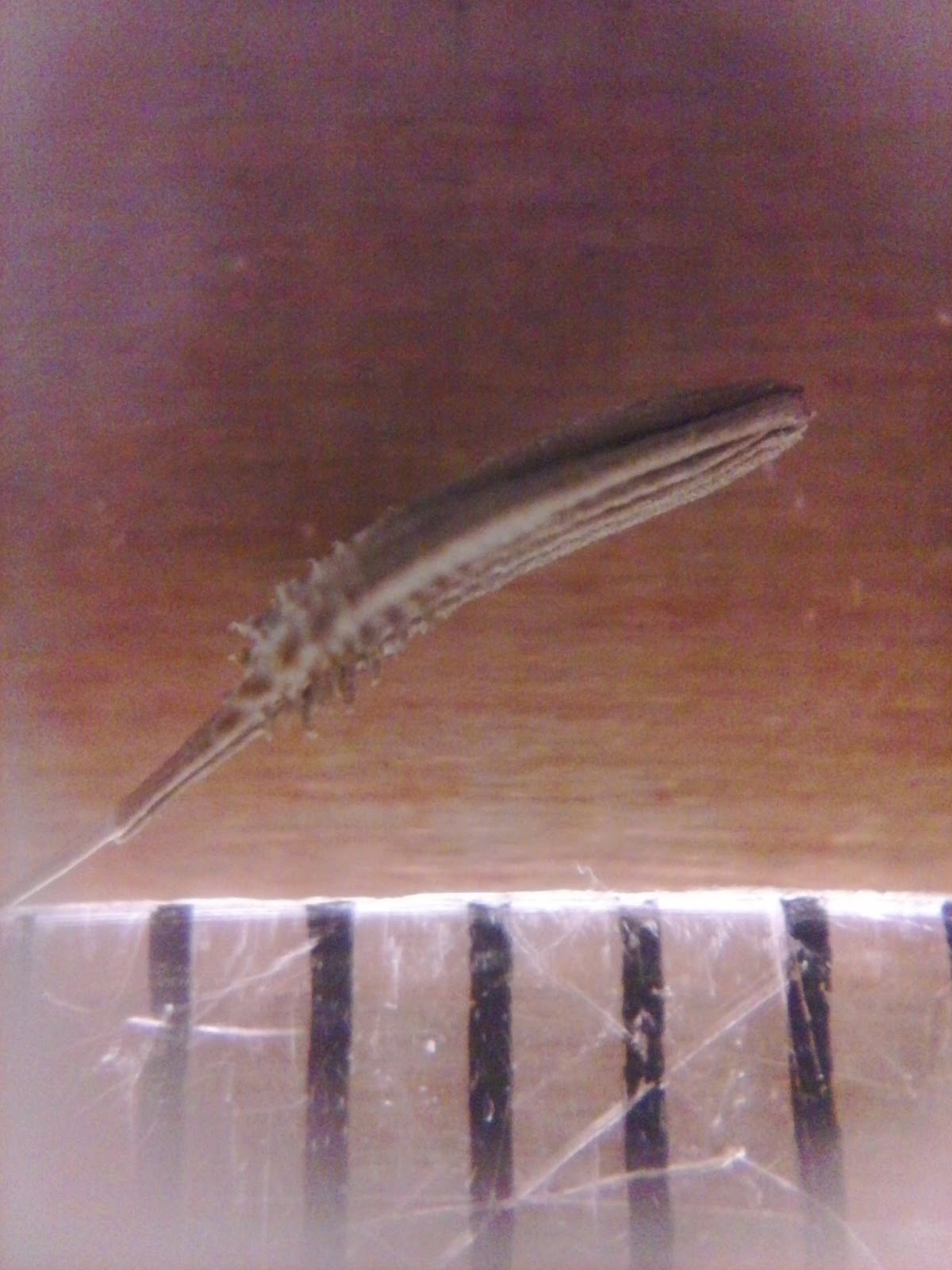
La foto de una semilla del diente de león. Observe que el tamaño de la foto es de 6 mm por 8mm.


Hoy nosotros conocemos los microscopios compuestos. El primer microscopio construido por Antonie van Leeuwenhoek  de Holanda también tenia un lente. El observo los animalitos en el agua potable con su microscopio en el siglo 17. Antonie nunca dijo el secreto de como construyo el lente de su microscopio. El microscopio de el era una lupa con el lente pequeño.  La habilidad del artesano es importante para las investigaciones científicas.  Otras personas no pudieron construir un microscopio tan bueno como Antonie en el siglo 17. Ellos sabian que necesitaban construir un lente pequeño pero no sabian como construirlo.

En mi microscopio, uso la cámara del teléfono en lugar de usar los ojos como lo hizo Antonie.

La amplificación del lente depende del radio del lente. Si una persona usa un lente mas pequeño puede obtener las imágenes de las células.  Para un proyecto en el futuro, voy a comprar los lentes de radios de 0,2 mm, 0,5 mm y 1,0 mm  para obtener las amplificaciones mas grandes como las obtuve con el lente del puntero láser. No necesito robar los secretos de Antonie para obtener  estos lentes. Ahora, hay fabricas que venden estos lentes en el mercado para transmitir señales a las fibras ópticas.  También me gustaria construir una plataforma de plástico transparente para tomar fotos sin problemas de movimiento. 


Aquí hay algunas fotos que yo tome con este microscopio. Mantener la posición de la cámara para tomar las fotos era difícil. Necesite usar un trípode para tomar algunas fotos en mi casa. Para otras, necesite usar una aplicación en mi teléfono que encendía el flash constantemente para dar mas luz y tomar las fotos. Por esta razón los microscopios modernos tienen luz para iluminar los objetos de investigaciones. 

La imagen de la pila cargando en la pantalla de mi computadora.


La imagen de arriba esta ampliada para mostrar que una persona puede ver cada pixel de la pantalla. Las imágenes de la  computadora se han construido usando tres colores de verde, azul y rojo. Posponemos la discusión sobre el color y el idioma a otro día.

Las puntas de dos bolígrafos.

El liquen en un árbol 

Una flor en el valle del río Columbia.

Las flores pequeñas. 

Un grano de avena


El musgo en un árbol en mi barrio.


El proyecto para construir un microscopio con papel, usando un lente pequeño para ayudar en los lugares donde no hay microscopios: http://www.ted.com/talks/manu_prakash_a_50_cent_microscope_that_folds_like_origami 

Unos de los artículos por web para convertir su teléfono a un microscopio: 

Monday, April 21, 2014

La primavera Llego a Portland

Marzo es el mes cuando la primavera llega a Portland. En el invierno los árboles tienen las ramas desnudas y el cielo tiene el color gris casi todo el día. En el noroeste de los Estados Unidos el invierno es la estación de lluvia- pero aquí la lluvia no es tan fuerte como la lluvia de las zonas tropicales. Casi cada día es gris. Gris en la mañana, gris al mediodía, y gris en la tarde; lo cual después de muchos años es deprimente.
El colibrí sobre una rama desnuda en mi barrio. Pero si tu observas con atención vas a ver los retoños pequeños.


Las ramas que parecen como lena cambian su color desde marrón a un color marrón rojizo, y tienen brotes en marzo.


Marzo es el mes cuando la primavera llega a Portland. En el invierno los árboles tienen las ramas desnudas y el cielo tiene el color gris casi todo el día. En el noroeste de los Estados Unidos el invierno es la estación de lluvia- pero aquí la lluvia no es tan fuerte como la lluvia de las zonas tropicales. Casi cada día es gris. Gris en la mañana, gris al mediodía, y gris en la tarde; lo cual después de muchos años es deprimente.

El mes de marzo tiene la esperanza de que todo el año no sea lo mismo. La primera señal del cambio son los narcisos. Las personas de Portland plantan los narcisos - en los parques, en los jardines en frente de las casas y las personas que no tienen un pedazo de tierra los compran en el mercado. La esperanza es que la escarcha no llegue! Cuando era niño leí la poesía que se llama “Daffodils” por William Wordsworth, pero en la India no entendía la alegría de ver los narcisos. Ahora no necesito ver diez mil narcisos como Wordsworth, una docena en el jardín de mi vecino fue suficiente para mí!
Un narciso esta mostrando su belleza 


El clima también empieza a cambiar poco a poco. En marzo algunos días tenemos la vista del dios sol; días cuando no necesitamos l0s impermeables; cuando pensamos que todo está bien con el mundo.


Los capullos de las flores sobre el árbol de magnolia
Si una persona no pone atención, no va a observar los pequeños retoños  y capullos en los árboles y plantas. Este año en el quince de Marzo, que fue un sábado yo observé un capullo sobre una magnolia. El segundo día este capullo cambió a una flor magnifica de color rosa, como el color que imaginado por un ejecutivo de una agencia de publicidad. Con mi cámara digital yo tomé casi diez fotos de esta flor, pero ninguna foto pudo capturar la belleza de la flor.


El capullo y el flor de magnolia sobre las ramas desnudas
Los árboles más magníficos son los cerezos. En el centro de la ciudad hay casi dos docenas cerezos los cuales tienen las ramas llenas de flores. Todo el invierno el árbol parece muerto, pero en un tiempo menos de un parpadeo de ojos se convierte en un objeto de otro mundo- cada rama llena de flores como una tienda de dulces. Desde la distancia, parecen como un globo rosa, y cuando una persona esta debajo del árbol parece como una cabeza de gigante con pelo rosa y con la perspectiva más cercana, tú ves que este espectáculo es por las flores pequeñas y perfectas.
Una explosión de las flores


Junco: Si se puede cantar con amor y fuerza a pesar de su pequeño tamaño.
El otro cambio por el clima es la canción de los pájaros. Los pájaros comunes en Portland como mirlo primavera (“Robin”), gorrión (“Song Sparrow”)  y “Junco” empiezan a cantar más frecuentemente en el mes de marzo. Según un científico, los testículos de los machos crecen diez veces más grandes, y ellos no pueden dejar de cantar por las hormonas que fluyen en su cuerpo! En la mañana cuando me desperté  yo escuché la llamada del pájaro robin- el sonido tiene la fuerza para entrar por las ventanas cerradas.Todo el año yo escucho el pequeño sonido como “chit-chit” del pájaro junco en mi barrio, pero en marzo el junco empieza a cantar su canción propia para atraer su pareja. Está canción suena como “sit-sit-sit-sit-sit-sit” por cinco o diez segundos. Un pájaro que pesa menos de treinta gramas tiene los pulmones fuertes. El “song sparrow” canta como su nombre “el gorrión de la canción”- “jit jit jit tu tu tu tu”, a veces sin interrupción por unos minutos. Los cuervos quienes son una presencia común cierran a cantar por las semanas cuando tienen polluelos, pero no he observado una reducción en su ruido este mes.


El gorrión de canción necesita mucho energía para cantar todo el día. Este gorrión estaba buscando por los gusanos en el suelo.
Una flor violeta esta disfrutando el sol y espera la visita de los insectos
Los pétalos en la tierra- una combinación de belleza y muerte
La temperatura en marzo no va a las setentas o a las ochentas, pero hay días donde una persona puede caminar sin un abrigo. El cambio de la naturaleza muestra que cada flor, pájaro y humano va ver el final del invierno en un ratito. El ciclo de las estaciones va a continuar, y el planeta tierra no cerró su viaje alrededor del sol.


Yo vi mi primera flor local de trillium el veintidós de marzo. Desde la tierra vacía brotó un flor- la vida de una semilla latente todo el invierno. La naturaleza es un milagro.
Ojala que veamos más sol y más flores en abril.


Wednesday, April 2, 2014

The first sighting of an owl in the wild

One of the downsides of always having lived in a city is that one does not get to see creatures that might be a common occurrence in the past. Take an owl for instance- there are so many reference to owls in literature and culture; but for me it was not something I could relate to- because I had never seen one in the wild. Till yesterday!

Sonya and I were returning home from a stroll to the rose garden. We were about to walk back on the sidewalk, when Sonya suggested that we take the trail instead. I was happy because I had my small compact camera with me- and with it I planned to take a picture of a trillium- which I had seen pop up from the barren ground on March 22- not an unusual way to become Thoreauesque in the 21st century. As I was walking along the trail, I kept my eyes peeled to the ground and was trying to remember on which turn I had seen the trillium with Sonya hurrying on ahead of me- anxious to get back home. I looked up to ponder which was the turn where the trillium might be.

With pure luck, I saw a large bird alight on a tree branch a 100 feet away. It had its head turned- and in the dull light of a usually drizzly Portland evening, I suspected that it might be the common red-tailed hawk. But then, it turned its head- and my heart skipped a beat- this thing was able to turn its head by nearly 180 degrees. It was paler than a hawk- IT WAS AN OWL!

It was a hundred yards from me on a tree to the left. I alerted Sonya - and motioned her in the direction of the bird- whispering "Owl". I did not want to point- but had to to show Sonya its location on the tree. I was remembering what I had heard from the great Harry Nehls- when I had taken a class with the Tualatin River Photo Society last fall- "owls are large birds and don't get scared easily. It is not going to fly away because it is scared of you. There are few things it is afraid of in the wild".

I removed my s90 camera from the jacket pocket and zoomed in all the way- to a paltry 105mm in 35mm equivalent. The exposure compensation was already set to minus two thirds, and it was taking raw files. All good. We slowly walked up on the trail to where we were closest to the bird. I was so thrilled to see the owl, resting on the branch, and scanning the scene around it and it finally turned its head, and looked at me for a few seconds allowing me to take 4 pictures, which I took by slowly raising my arms in front of me while holding the camera as steadily as possible for the shutter speed of 1/6th of a second. The light was low- the pictures were at iso 1600 with f4.9. In one the head was turned away from the camera, in two others, the picture was shaky- but the fourth one was the best- which you can see below.
Me thinks it was a "Barred Owl"


We walked on, with me ahead of Sonya, still intent on finding the trillium- we had seen our owl- for 10 seconds on that branch- and did not want want to spook it too much. As we continued walking on the path, Sonya cried out "Sugata! Sugata!". I turned around back to find Sonya ducking, and the owl silently gliding parallel to the path. It landed on a tree 50 feet ahead on the path to our left. 

After pausing for a second, we continued on. As we came to the spot, where we were closest to the owl, we stopped and eyed each other again for a few seconds. We continued on, and as we looked back, the owl flew- SILENTLY- and landed on a tree 200 feet away from us, and then took off. I was thinking of all the little birds we had seen on the walk- the noisy song-sparrows, juncos, robins and even a spotted towhee. They would not stand a chance with this evolutionary tuned beast capable of silent flight.

And yes, I did get my trillium picture.


The trillium

Today morning, I woke up with an "AHA" moment. Earlier on the walk yesterday, near the Japanese garden, we had seen a murder of crows causing a ruckus. Perhaps, they had seen this owl before us.